You can start working remotely without years of experience, but not in every job and not by answering ads that promise easy money. This guide lists the entry-level remote jobs that employers in Canada actually fill with beginners, shows where they can lead, and explains how to build proof of your skills when your resume is still thin.
Realistic entry-level remote jobs
Remote employers hire beginners where training is standardised and the work is easy to check. That points to a handful of job families:
| Role | What you do | What helps you get it |
|---|---|---|
| Customer support agent | Answer customer questions by chat, email or phone | Customer-facing experience, clear writing, calm tone |
| Data entry / admin assistant | Enter, check and clean records, update spreadsheets | Accuracy, spreadsheet basics, typing speed |
| Content moderator | Review posts, images or ads against platform rules | Good judgment, reading speed, resilience |
| Virtual assistant | Manage email, calendars, bookings and documents | Organisation, Google Workspace or Microsoft 365 |
| Transcription and captioning | Turn audio and video into accurate text | Excellent spelling, listening, style-guide discipline |
| Sales development rep | Contact potential customers and book meetings | Confidence on the phone, resilience with rejection |
Customer support is the largest of these – our guide to remote customer service jobs covers it in depth. For an overview of all remote fields, start with remote jobs in Canada.
What “no experience” really means
“No experience required” in a legitimate ad usually means no experience in this exact role. Employers still expect reliable basics: working computer skills, a stable internet connection, written English (and sometimes French), and evidence that you show up and finish things. Retail, food service, volunteering, school projects and caring for family members all provide that evidence if you describe them concretely.
Where a first remote job can lead
An entry-level job is a start, not a ceiling. People who do the job well for a year or two often move into roles that pay more and require judgment rather than speed. The paths below are common patterns, not promises – they depend on the employer and on you asking for more responsibility.
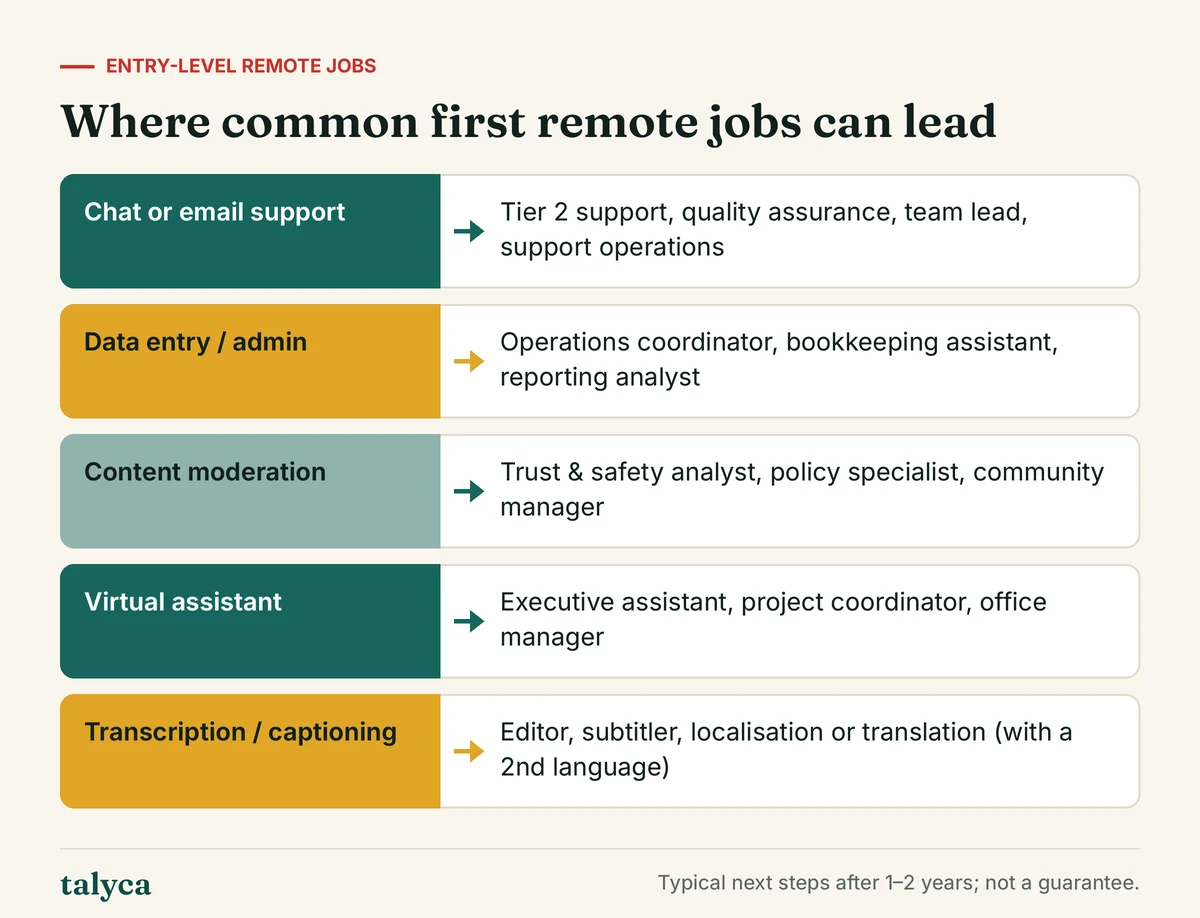
To move up, keep a running list of things you improved: a macro you wrote that saved time, a process document you created, a new colleague you trained. Those items are what a promotion case or your next resume will be built on.
No experience? Build proof instead
When you can’t point to a previous remote job, point to work you can show. You don’t need expensive courses for this: small, specific samples tied to the jobs you are applying for are more convincing than a certificate.
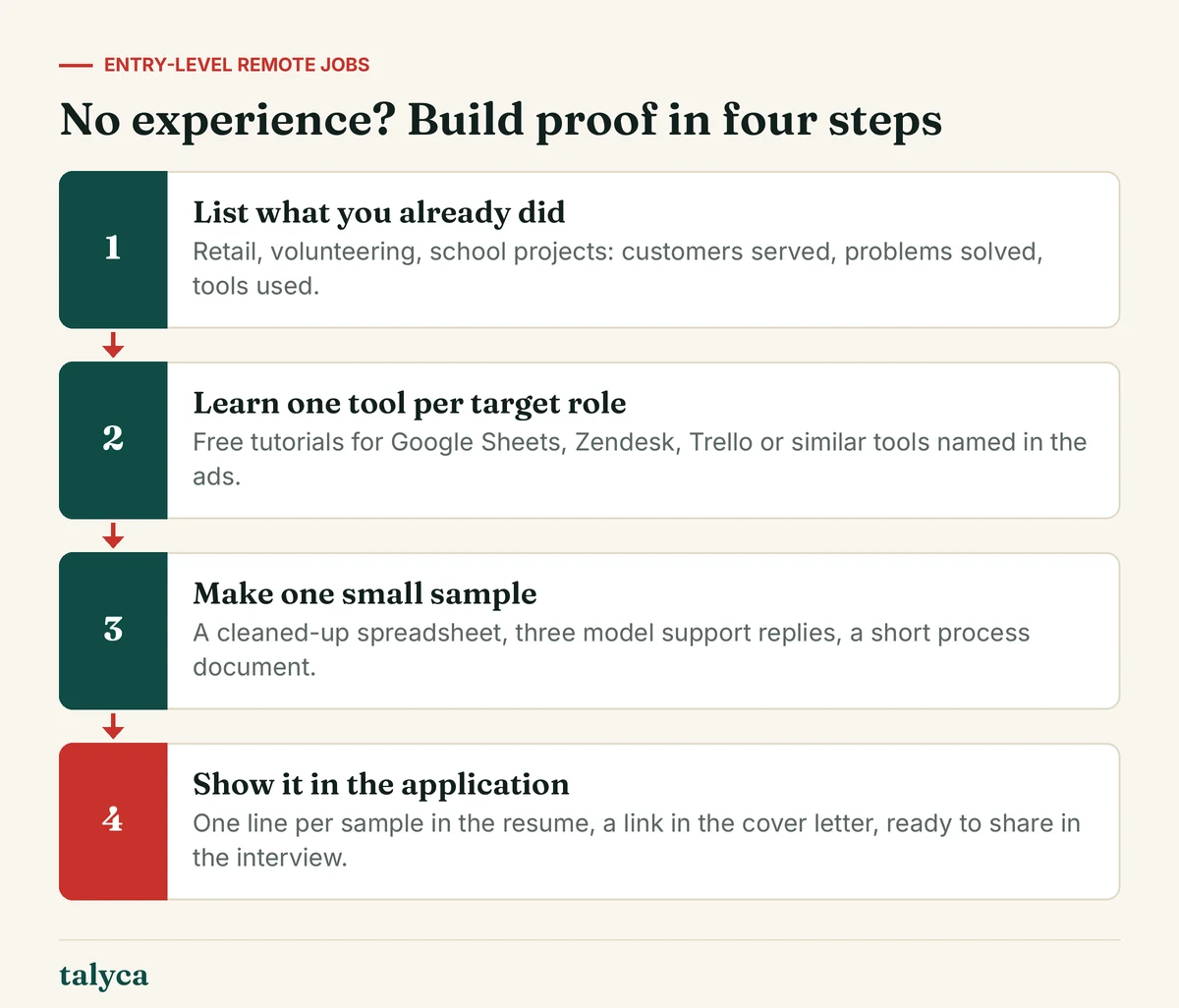
Examples of samples that take an evening or two:
- Support: three model replies to realistic customer emails – a refund request, a delayed order, an angry complaint.
- Data entry and admin: a messy public spreadsheet you cleaned up, with a short note on what you fixed and how.
- Virtual assistant: a one-page process for booking travel or onboarding a new client.
- Transcription: a short transcript of a public-domain recording, following a published style guide.
Keep the samples free of other people’s personal data. Put them in a shared folder or simple portfolio page and link to it in your resume or cover letter.
Part-time and flexible options
Many beginners are looking for part-time remote work alongside school, caregiving or another job. Options exist, but a few rules of thumb help:
- Part-time is not the same as flexible. A part-time support job still usually has fixed shifts. Truly flexible hours are more common in email support, transcription and freelance work.
- Seasonal roles – before the holidays, during tax season, in travel peaks – are a common way in and can turn into permanent positions.
- Task and gig platforms for things like transcription, testing or data labelling pay per task. They can be legitimate, but income is irregular and you are usually a contractor. Read freelancing in Canada for what that means for taxes and CPP.
The most common trap for beginners: ads that promise high pay for simple “data entry”, “product testing” or “liking videos”, and then ask you to pay a fee, deposit a cheque or top up an account to unlock tasks. Genuine employers never charge you. Our guide to remote job scams lists the warning signs.
Your first month in a remote job
Remote beginners are judged quickly, often during a probation period, and mostly on reliability. What makes a good start:
- Be visibly on time: log in a few minutes early, respond when your status says available.
- Ask in writing, then search: check the knowledge base first; if you still need help, ask a precise question in the team channel. People appreciate “I checked article X, but it doesn’t cover Y”.
- Take notes: build your own cheat sheet of processes and shortcuts in the first weeks.
- Get feedback early: ask your lead after two weeks what you should do more or less of.
- Protect your routine: a fixed start time, a dedicated workspace and real breaks keep remote work sustainable.
Before you start, know your basic rights as an employee – pay for training time, breaks, overtime. They are explained in working from home in Canada.
Applying as a beginner
With little experience, your application has to make the most of what you have. Keep the resume to one page, start with a two-line profile that names the role you want, list relevant skills and tools, and describe past jobs with concrete tasks. Add a short cover letter or note that links to your sample. The full walkthrough is in applying for remote jobs in Canada, and current openings are on the jobs page.
Go deeper on this topic:
- Content Moderator Jobs in Canada: What the Work Is Really Like – What remote content moderators do, how hiring works, the real upsides and downsides, and questions to ask about wellness support.
- Virtual Assistant Jobs in Canada: Tasks, Tools and How to Start – What virtual assistants do, the tools clients expect, employee vs.
Common questions about entry-level remote jobs
What is the easiest remote job to get with no experience?
Customer support at larger companies and outsourcers is the most accessible, because they hire in numbers and train new agents. Data entry roles exist but attract many applicants and many scams, so check every offer carefully.
Do I need a degree for an entry-level remote job?
Usually not. Most support, admin and moderation roles ask for a high school diploma or equivalent; skills, reliability and a good application matter more.
Can students work remote jobs in Canada?
Yes, Canadian and permanent resident students can work part-time remote jobs like anyone else. International students have to follow the work conditions of their study permit, which can limit hours during term.
Are data entry jobs from home real?
Some are, typically as part of an administrative role with a named employer. Ads that promise high pay for simple typing with no interview, or that ask for a fee, are scams.
How long does it take to find a first remote job?
It varies a lot with the field, your region and the season. Applying consistently to well-matched roles and tracking the results is the fastest way we know to improve your odds.