Many remote jobs are really contracts: you invoice a client instead of receiving a paycheque. That makes you self-employed in Canada, with your own obligations for tax, CPP and possibly GST/HST. This guide explains how freelancing works from registration to invoices, with a worked CPP example for 2026 and a quick test for whether you need a GST/HST number.
Employee or contractor?
Whether you are self-employed depends on the actual working relationship, not only on what the contract calls you. The Canada Revenue Agency looks at questions such as: who controls how and when the work is done, who provides the tools, whether you can hire helpers or work for others, and whether you carry financial risk and can profit from managing the work well.
- Typical contractor: several clients, own equipment, you decide how to deliver the result, you invoice per project or hour.
- Typical employee: one employer, fixed hours set by them, their tools and processes, supervised like the rest of the team.
If a client treats you like an employee but pays you as a contractor, you lose EI coverage, employer CPP contributions and employment standards protection such as vacation pay. The CRA can rule on your status for CPP and EI if you ask. The employee side of remote work is covered in working from home in Canada.
Getting set up
You can start freelancing as a sole proprietor under your own name without any registration. A few steps make life easier:
- Business name: if you trade under a name other than your own, most provinces require you to register it.
- Business number (BN): the CRA issues it when you register for a program such as GST/HST. Many freelancers only need one once they register for GST/HST.
- Separate bank account: not legally required for sole proprietors, but it keeps income and expenses easy to track.
- Record keeping: keep invoices, receipts and bank statements. The CRA generally requires records to be kept for six years from the end of the tax year they relate to.
- Licences: some regulated services need a provincial licence or membership, and some municipalities require a business licence even for home-based businesses.
GST/HST: when you have to register
You must register for GST/HST once your worldwide taxable revenues from supplies of goods and services exceed $30,000 – either in a single calendar quarter or over the last four consecutive calendar quarters. Below that, you are a small supplier and may register voluntarily.
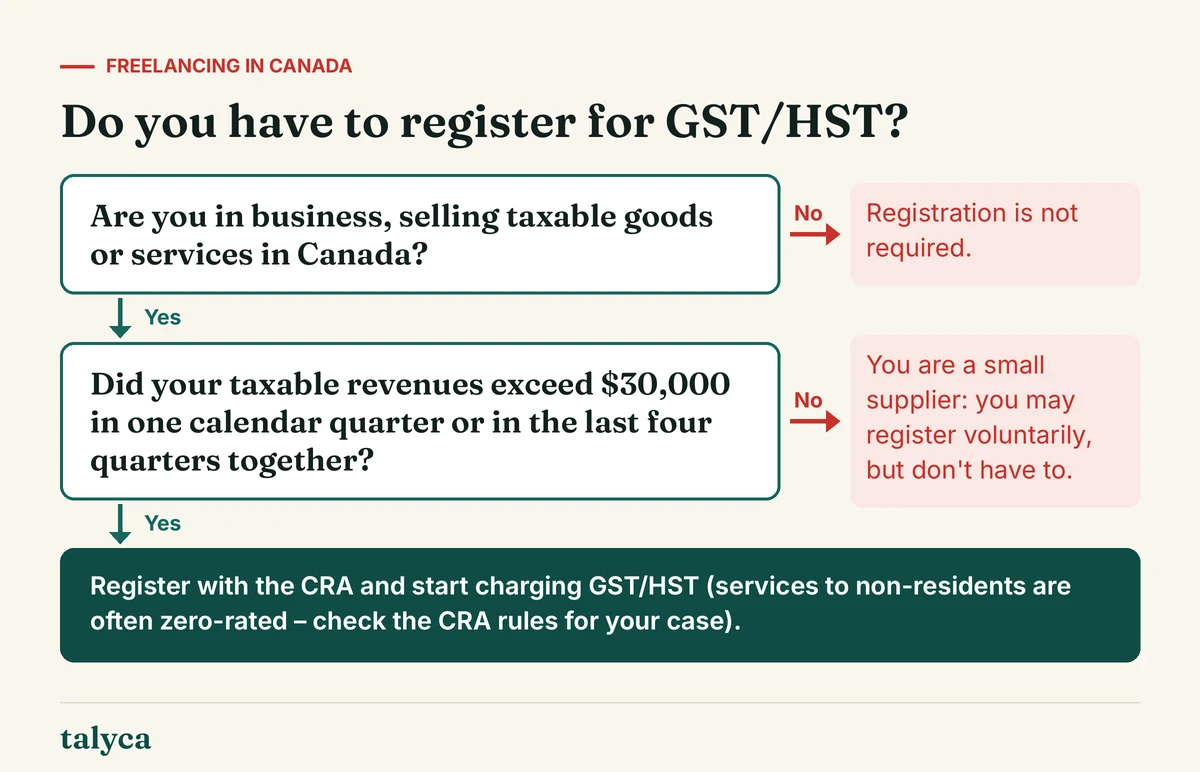
After registering, you charge GST or HST on your taxable services, file returns, and can claim input tax credits for the GST/HST you paid on business expenses. The rate depends on where your client is, not where you are: 5% GST in some provinces, a higher harmonized HST rate in others. Services supplied to clients outside Canada are often zero-rated – taxable at 0% – but the rules have conditions, so check the CRA guidance for your situation.
Voluntary registration can make sense if you have significant business expenses (you can recover the GST/HST you paid) or if your clients are GST/HST-registered businesses that can claim back what you charge them. For clients who are consumers, it simply makes you more expensive.
Income tax and CPP
As a self-employed person you report your business income on form T2125 with your personal tax return. You pay income tax on your net income – revenue minus eligible business expenses – at the same rates as everyone else. The difference is that nobody withholds it for you.
CPP for the self-employed
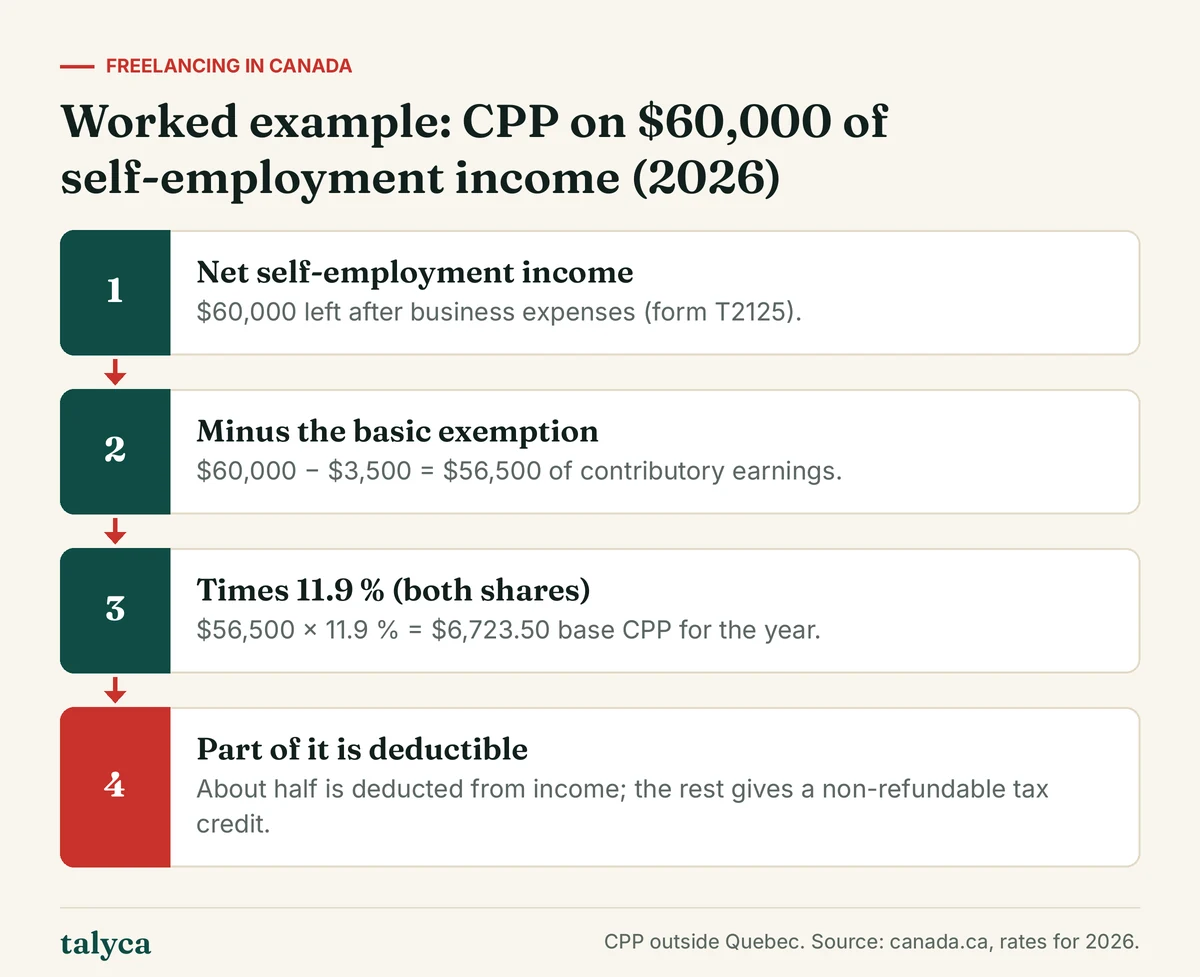
Outside Quebec, you pay both the employee and the employer share of Canada Pension Plan contributions on your net self-employment earnings. For 2026 the base rate for the self-employed is 11.9% on earnings between the $3,500 basic exemption and the maximum pensionable earnings of $74,600. On earnings between $74,600 and $85,000, a second contribution (CPP2) of 8% applies. In Quebec, the Quebec Pension Plan applies instead, with its own rates.
Instalments and deadlines
If you are self-employed, your tax return is due by June 15, but any balance owing is still due by April 30. When your net tax owing exceeds $3,000 (or $1,800 in Quebec) in the current year and in either of the two previous years, the CRA will ask you to pay by quarterly instalments. A simple habit protects you: move a fixed share of every payment you receive into a separate savings account for tax.
EI
Self-employed people are not covered by regular EI. You can opt in to EI special benefits (such as maternity, parental and sickness benefits) by registering and paying premiums; there is a waiting period before you can claim.
Business expenses you can deduct
Reasonable expenses you incur to earn your business income are deductible. Typical examples for remote freelancers:
| Expense | Note |
|---|---|
| Software subscriptions, hosting, domains | Business share only if you also use them privately |
| Computer, monitor, phone | Larger items are usually depreciated over several years (capital cost allowance) |
| Internet and phone plan | Business-use portion |
| Business-use-of-home expenses | Proportion of rent, utilities and similar costs; conditions apply and they can’t create a loss |
| Professional fees, courses, memberships | Related to your current business |
| Bank and payment platform fees | Including currency conversion fees on client payments |
No tax advice: this guide explains the general rules as published by the CRA (updated September 2026). Your situation may differ; for complex cases, talk to an accountant or check canada.ca.
Contracts, invoices and foreign clients
A short written contract prevents most disputes. It should cover the scope of work, deliverables and deadlines, the rate and payment terms (for example, 14 or 30 days), how many revisions are included, who owns the work product, confidentiality, and how either side can end the arrangement.
A proper invoice includes your name or business name and address, the client’s name, an invoice number and date, a description of the services, the amount, and – if you are registered – your GST/HST number and the tax charged.
Working for clients abroad
- Tax: as a Canadian resident you report your worldwide income in Canada, including income from foreign clients.
- US forms: US clients often ask non-US contractors for a form W-8BEN to document that you are not a US person.
- Currency: agree on the currency in the contract and compare conversion fees between your bank and payment services.
- Platforms: freelance marketplaces take a fee and have their own rules on payment and disputes – read them before you accept work.
Contract roles appear regularly among the remote jobs open to Canada; many tech roles in particular are offered this way (see remote tech jobs). Be wary of “clients” who overpay and ask for a refund – a variation of the fake cheque scam described in remote job scams.
Go deeper on this topic:
- How to Invoice as a Freelancer in Canada – What a Canadian freelance invoice must show, GST/HST on invoices, payment terms, foreign currency and getting paid on time.
- Tax Instalments for the Self-Employed in Canada – When the CRA requires quarterly instalments, the due dates, the three calculation options and how to set money aside as a freelancer.
Common questions about freelancing in Canada
Do I need to register a business to freelance?
Not if you work under your own name as a sole proprietor. You need to register a business name if you use a different one, and a GST/HST account once you pass the $30,000 threshold.
Do I charge GST/HST to clients outside Canada?
Services supplied to non-residents are often zero-rated, meaning you charge 0% but still report them. The conditions depend on the service and client, so check the CRA’s guidance for exported services.
How much should I set aside for tax?
That depends on your income, province and expenses. Many freelancers set aside a fixed percentage of every payment, covering income tax and CPP, and adjust after their first tax return.
Can I freelance while I have a job?
Yes, unless your employment contract restricts it. You report both incomes; CPP already paid through your job is taken into account when your self-employment contributions are calculated.
What if I earn less than $30,000 a year?
You don’t have to register for GST/HST, but you still report all your income and pay income tax and CPP on your net self-employment earnings.