Remote jobs open to people in Canada exist in almost every office field, but “remote” in a job ad can mean very different things. This guide explains which remote jobs employers actually hire for, how to read where an employer is allowed to hire, where to search, and how to run a search that leads to interviews rather than silence.
What “remote” means in a Canadian job ad
A remote job is one where you do the work away from the employer’s office, usually from home. That sounds simple, yet job ads use the word for at least three different arrangements:
- Fully remote: no office days at all. You may still have to live in a certain country, province or time zone.
- Remote-first with meetups: you work from home, but the team meets in person a few times a year. Travel is normally paid by the employer – ask if the ad doesn’t say.
- Hybrid: a fixed or flexible number of office days per week or month. Many ads labelled “remote” on job boards are really hybrid, so read the full description before you apply.
The practical question is never just “is it remote?”, but “can this employer hire me where I live, and on what terms?” That answer is hidden in the location line.
How to read the location line
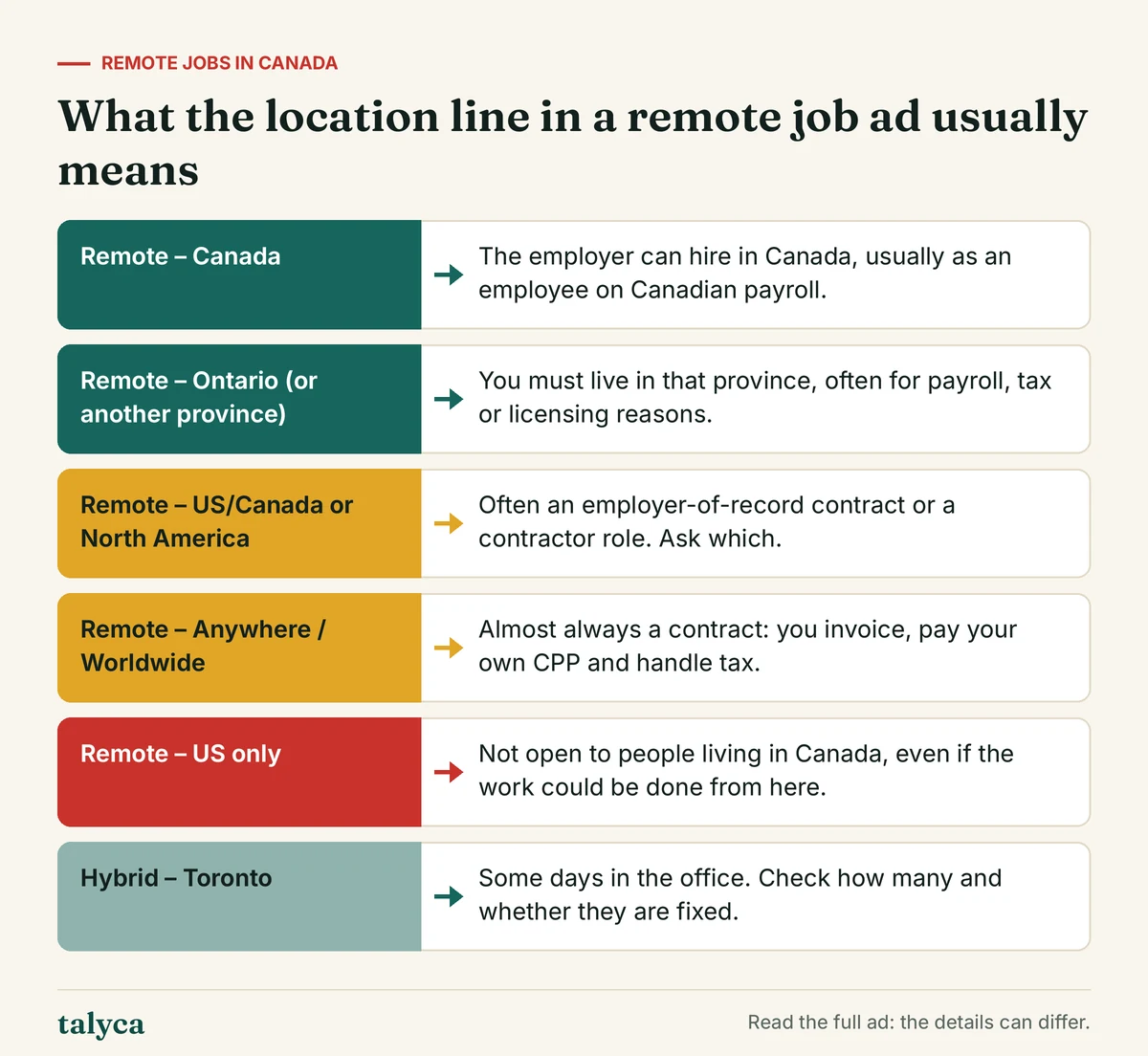
Employers have to run payroll, withhold tax and follow employment law in the place where their employee works. That’s why a company that is happy to let you work from your kitchen table may still only accept applicants from certain provinces or countries. The diagram shows how the most common labels are usually meant.
Two details are easy to miss:
- Province restrictions. A Canadian employer registered in only a few provinces may limit hiring to those provinces. Regulated work – nursing, pharmacy, insurance, law, some financial advice – also requires a licence in the province where the client or patient is.
- Time zones. “Remote – Canada (EST hours)” means you are expected online during Eastern business hours. From British Columbia that is a 6 a.m. start. Check it before you apply, not after the offer.
Tip: If a US company’s ad says “US/Canada”, ask early whether they hire Canadians as employees through an employer of record or only as contractors. The difference changes your take-home pay, benefits and taxes. Our guide to freelancing in Canada explains the contractor side.
Which remote jobs employers hire for
Remote work clusters in jobs that happen on a computer and are measured by output rather than presence. The table lists the fields where remote openings for Canada show up most regularly, with the kind of first step people take in each.
| Field | Typical remote roles | Usually expected |
|---|---|---|
| Customer support | Chat, email and phone support agent, customer success | Clear writing or speaking, patience, a quiet workspace; French is often a plus |
| Software and IT | Developer, QA tester, IT help desk, DevOps | Demonstrable skills, portfolio or GitHub, often a technical task |
| Sales | Sales development rep, account executive | Comfort with calls and targets, a CRM such as HubSpot or Salesforce |
| Administration | Virtual assistant, data entry, scheduling, bookkeeping assistant | Accuracy, spreadsheets, discretion with confidential data |
| Marketing and content | Writer, editor, social media, SEO, designer | Samples of past work, familiarity with the tools named in the ad |
| Finance and HR | Accounts payable, payroll, recruiter, HR coordinator | Canadian rules knowledge, sometimes a designation (CPA, CPHR) |
If you are just starting out, the most realistic doors are support, administration and moderation; our guide to entry-level remote jobs covers them in detail. For support work specifically, read remote customer service jobs; for development, IT and data, see remote tech jobs.
Where to search
No single site has every remote job. A good search combines a few sources:
- Remote job boards that filter by where you may work. On Talyca’s job listings every job is open to applicants living in Canada, and each listing links to the original source.
- Job Bank, the Government of Canada’s job site, which also publishes wage information by occupation and region – useful for checking whether an offered pay is realistic.
- Company careers pages. Make a list of 20 to 30 companies you would like to work for and check their careers pages every week or two. Jobs often appear there before they reach aggregators.
- LinkedIn, where the “remote” filter plus “Canada” as location is a quick first pass. Recruiters also post roles there that aren’t advertised elsewhere.
- Your network. Former colleagues, classmates and online communities around your field. A referral usually gets a human to read your resume.
Careful: Messages that offer you a remote job you never applied for, often through WhatsApp, Telegram or text, are a common start of a scam. Read our guide to remote job scams in Canada before you reply to any unsolicited offer.
A search routine that works
Remote roles attract applicants from across the country, so sending the same resume to a hundred ads rarely works. Fewer, well-matched applications do better. This weekly routine keeps the effort manageable:
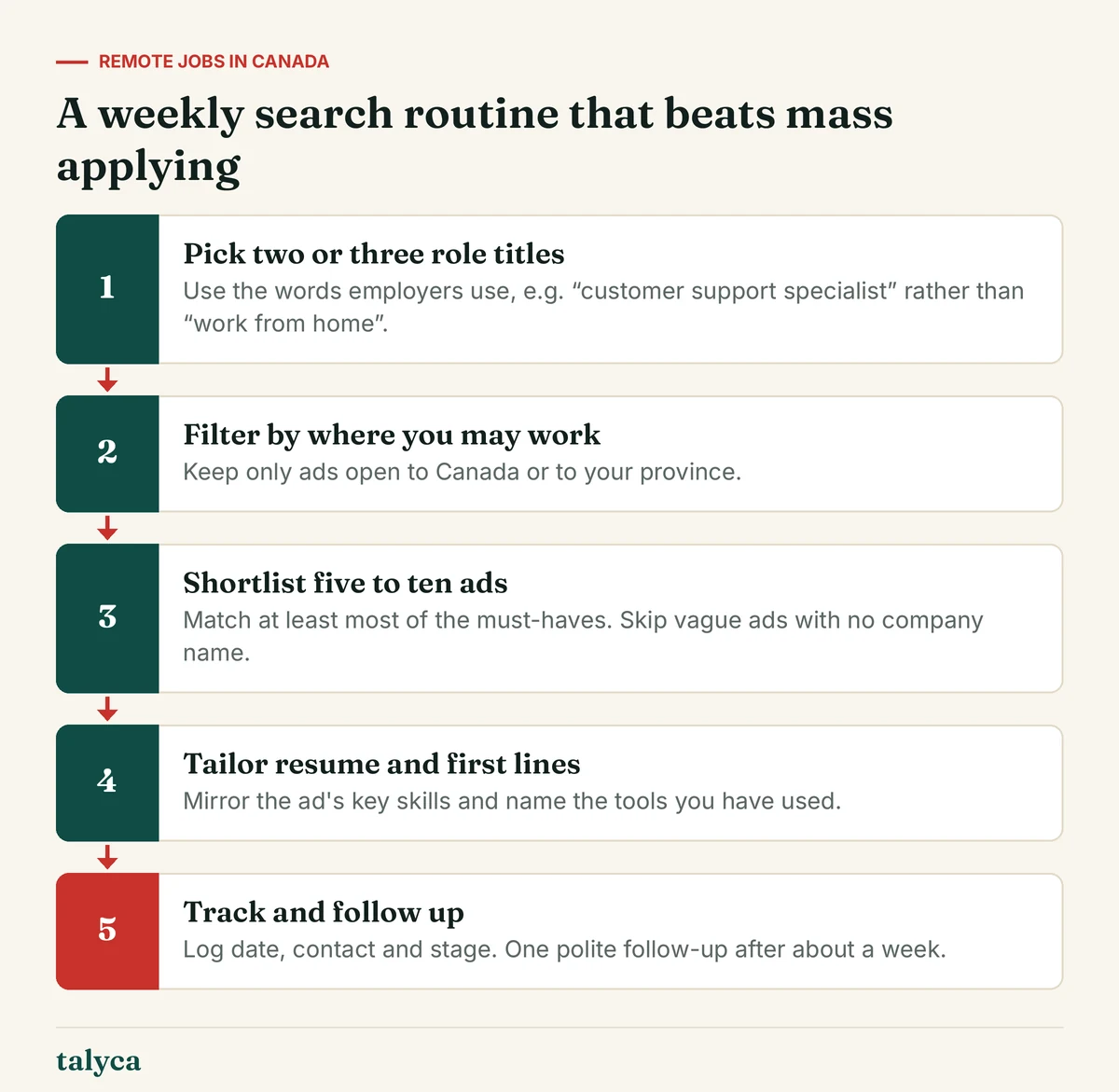
A simple spreadsheet is enough for tracking: date, company, role, link, contact, stage and next action. After four weeks you’ll see a pattern – maybe support roles answer and marketing roles don’t, or maybe applications through company pages get more replies than those through large boards. Adjust accordingly.
For the application itself – resume format, cover letter and the video interview – see applying for remote jobs in Canada.
Pay, contracts and what to check before you sign
Remote jobs pay in the same range as comparable office jobs; some employers adjust pay to your location, others pay one national rate. Before you sign an offer, check these points in writing:
- Employment type: employee (with source deductions for tax, CPP and EI) or independent contractor (you invoice and pay your own).
- Which employment standards apply: for most employees, those of the province where you work. Our guide to your rights and taxes when you work from home explains the rules.
- Hours and time zone: core hours, shifts, weekend or on-call duties.
- Equipment: who provides the laptop, headset and monitor, and whether there is an internet or home office allowance.
- Pay in which currency: a salary in US dollars paid to a Canadian account means exchange-rate risk and bank fees.
- Probation and notice: length of probation and what happens after it.
Minimum wage applies to remote employees too. For federally regulated employers, such as banks and telecom companies, the federal minimum wage has been $18.15 an hour since April 1, 2026; everyone else falls under the minimum wage of their province or territory, which you can look up on your provincial government’s website.
Go deeper on this topic:
- Working Remotely Across Canadian Time Zones: Shifts, Overlap and Pay – What an Eastern Time shift means in BC or Newfoundland, how to ask about core hours, and how to handle overlap with US and European teams.
- Employer of Record: How Foreign Companies Hire Remote Workers in Canada – How a foreign company employs you in Canada through an employer of record.
Common questions about remote jobs in Canada
Can I work remotely for a US company while living in Canada?
Yes, if the company is set up to pay you. Many hire Canadians through an employer of record, which becomes your legal employer in Canada, or as independent contractors. A company without either arrangement usually can’t hire you as an employee, which is why some ads say “US only”.
Do I need to live in the province named in the ad?
Usually, yes. The employer registers for payroll and follows employment standards in that province, and for licensed professions your licence must match the province. Moving without telling your employer can break your contract.
Are remote jobs harder to get than office jobs?
They often attract more applicants, because the ad reaches the whole country. You compensate by applying to fewer, better-matched roles, naming the tools you know and showing that you work well on your own.
Is a job that is advertised only through a messaging app legitimate?
Very rarely. Legitimate employers advertise on their own careers page or on job boards and interview by video or phone. An offer through WhatsApp or Telegram without a real interview is a classic warning sign.
Do I pay tax differently when I work remotely?
Not as an employee on Canadian payroll: tax and CPP are deducted as usual. As a contractor, or when a foreign employer withholds no Canadian tax, you pay yourself, possibly by instalments. You may be able to deduct home office expenses in some cases.