Job scams are among the frauds most often reported in Canada, and remote jobs are an ideal disguise: no office to visit, interviews by message, and a promise of easy money from home. This guide explains the most common schemes, lists 12 warning signs, shows how to check an employer in ten minutes, and tells you what to do and where to report if you have already responded.
The most common remote job scams
The details change constantly, but most fake remote jobs follow a handful of patterns. The goal is always one of three things: your money, your identity, or your bank account to move someone else’s money.
| Scheme | How it looks | What they want |
|---|---|---|
| Fake cheque | You are “hired” and receive a cheque to buy equipment or pay a supplier | The money you send on before the cheque bounces |
| Task scam | Paid “tasks” such as rating products or liking videos; small first payouts, then you must top up an account to unlock more | Your deposits, often in crypto |
| Reshipping | “Quality control” or “logistics” job receiving parcels and sending them abroad | To launder goods bought with stolen cards – you can end up involved in a crime |
| Money mule | “Payment processing” job receiving money into your account and forwarding it | Your account to launder fraud proceeds |
| Fake onboarding | A quick “offer” followed by forms asking for SIN, ID photos and banking details | Your identity, to open accounts or claim benefits |
| Fee scam | Paid training, certification, starter kits or background checks | The fee |
Fraudsters also impersonate real companies and recruiters, copying logos, job titles and even names of real employees. A familiar brand in the message proves nothing.
How a fake cheque scam works
The fake cheque scheme deserves a closer look, because it catches careful people. It relies on the fact that a bank can make deposited funds available within days, long before the cheque has actually been confirmed by the issuing bank.
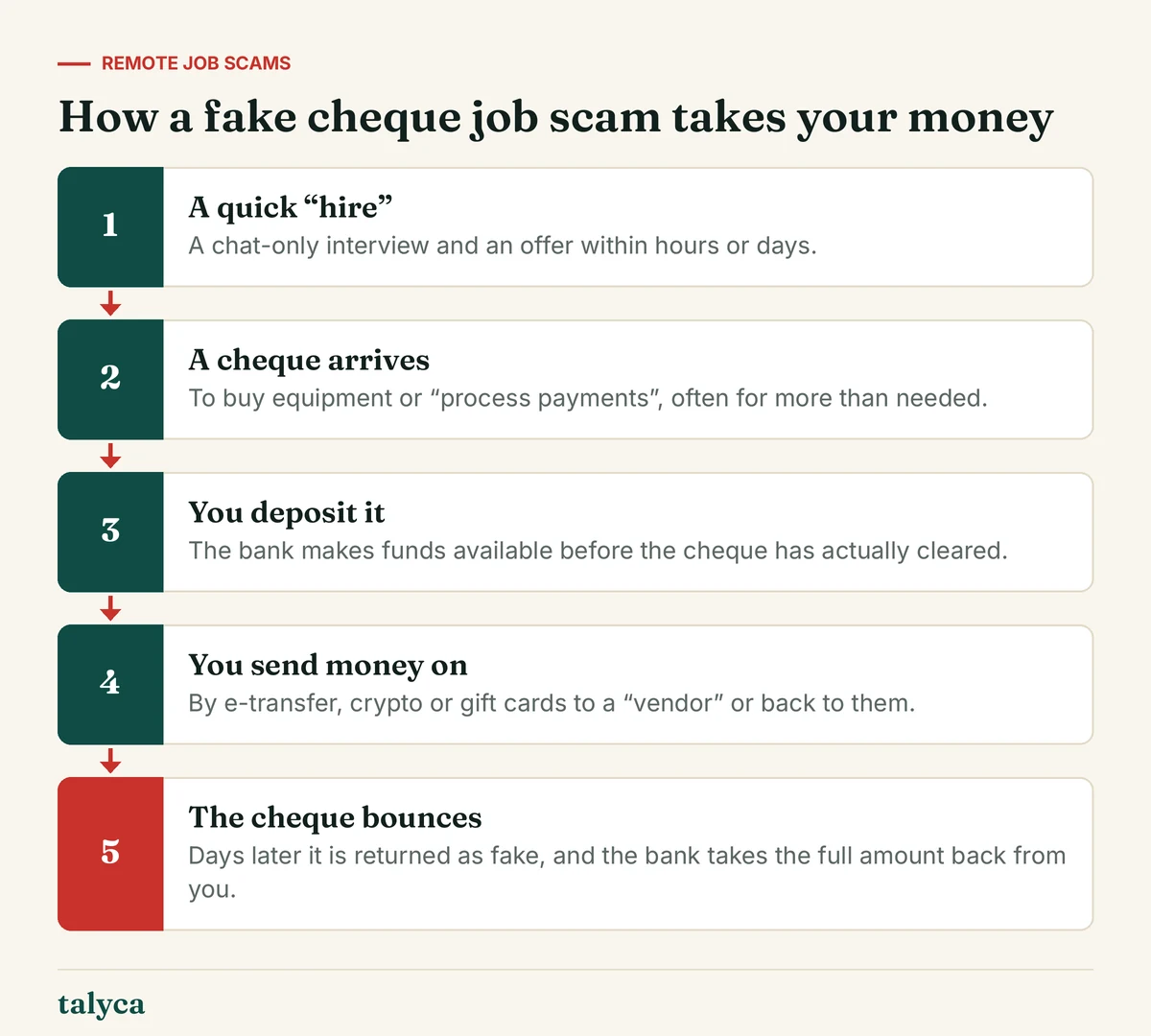
The same logic applies to overpayment variations: “we sent too much, please refund the difference”. No real employer sends you money to pass on to someone else.
12 warning signs
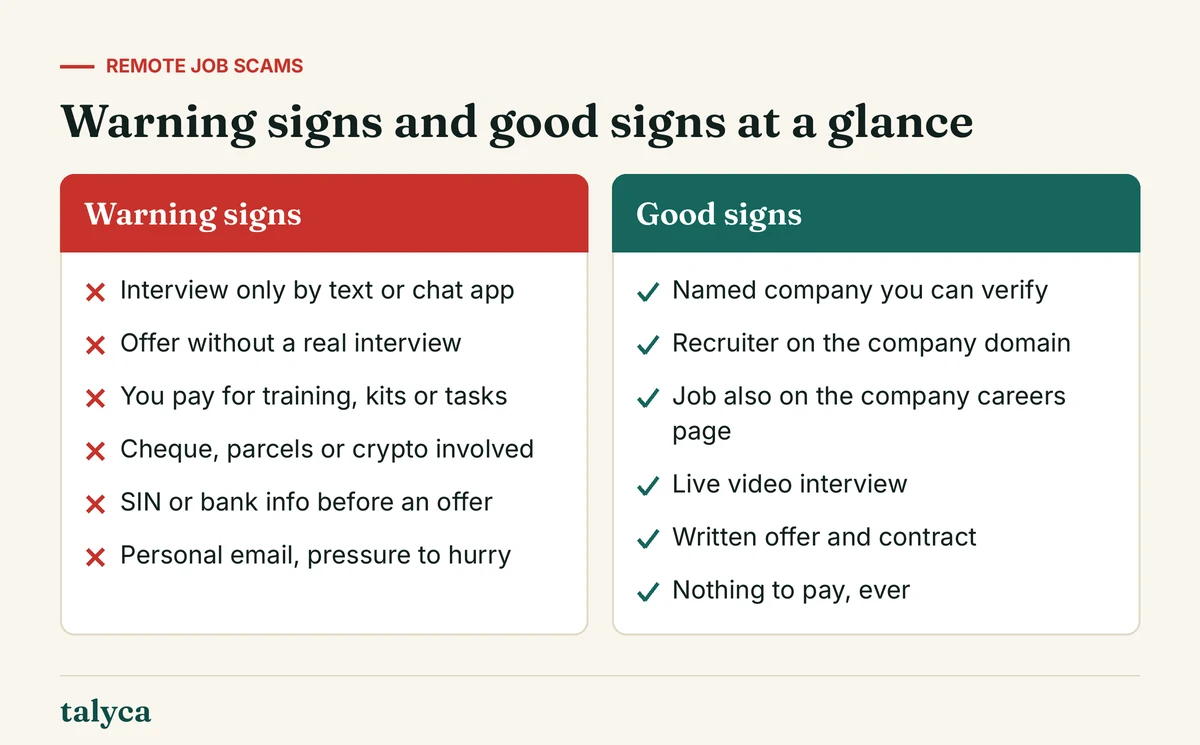
A single sign doesn’t prove fraud, but two or three together should make you stop and verify before you share anything.
- You were contacted for a job you never applied for, often by text, WhatsApp, Telegram or social media.
- The interview happens only by text chat, or there is no real interview at all.
- The offer comes unusually fast – hours after first contact.
- The pay is high for simple work with no experience required.
- You have to pay something: training, a starter kit, software, a background check, or a deposit to unlock tasks.
- A cheque or money transfer is involved that you must partly pass on.
- You are asked to receive and reship parcels or to “process payments” through your own account.
- They want your SIN, ID or bank details early, before a written offer.
- The recruiter uses a personal email address (Gmail, Outlook) or a domain that is slightly different from the company’s.
- The job doesn’t appear on the company’s own careers page.
- There is pressure to hurry – “only three spots left”, “decide today”.
- Payment is in crypto, gift cards or through an app you are asked to install.
How to check an employer in ten minutes
Before you send documents or accept an offer from a company you don’t know, run through these checks:
- Find the company’s official website yourself (not through the link in the message) and look for the job on its careers page.
- Check the email domain against the official website. Look out for extra letters, hyphens or different endings.
- Look up the recruiter on LinkedIn and compare – but remember that profiles can be faked, too. If in doubt, contact the company through its website and ask whether the person works there.
- Search the company name with “scam” or “fraud” and check the warnings published by the Canadian Anti-Fraud Centre.
- Look up the business in the federal or provincial corporate registry if a Canadian company is named.
- Ask for a video interview with a named person. Scammers tend to avoid them.
Rule of thumb: a genuine employer pays you – you never pay them, and you never move money for them. That one rule would stop most job scams.
The normal order of a real hiring process is described in applying for remote jobs in Canada; any step that happens much earlier than it should is a reason to pause.
If you have already responded
Act quickly – the sooner you do, the more you can limit the damage. It’s not a reason for embarrassment: these schemes are run by professionals.
- Stop contact and don’t send any more money or documents. Don’t deposit a cheque you received, and don’t forward parcels.
- Contact your bank or card issuer using the number on your card. Report the transactions and ask whether a payment can be stopped.
- If you shared your SIN or ID, contact Service Canada about your SIN and ask Equifax and TransUnion Canada to place a fraud alert on your credit file.
- Change passwords for any account you used with them and enable two-factor authentication. If you installed software they sent, have the device checked.
- Keep evidence: messages, emails, phone numbers, the job ad, transaction receipts.
- Report it (see below).
Where to report job fraud in Canada
- Canadian Anti-Fraud Centre (CAFC): 1-888-495-8501 or online through the reporting system linked on antifraudcentre-centreantifraude.ca. Reports help warn others even when money can’t be recovered.
- Your local police, especially if you lost money or your identity was used. Ask for a file number – your bank may need it.
- The platform where you saw the ad or received the message: job board, LinkedIn, the messaging app.
- Talyca: if the listing was on our site, tell us through the contact form and we will check and remove it.
Staying safe while you search
You don’t have to avoid remote work to avoid scams – just keep a few habits. Apply through company careers pages or trustworthy job boards, keep your SIN and date of birth off your resume, use a separate email address for job searching, and never let urgency push you past verification. Legitimate remote jobs are described in our guides to remote jobs in Canada and entry-level remote jobs.
Go deeper on this topic:
- Task Scams: Why “Paid Online Tasks” Offers End in Losses – How task scams work step by step, why the first payouts are real, warning signs and what to do if you’ve already deposited money.
- How to Check if a Recruiter Is Real Before You Share Anything – Domain checks, careers pages, LinkedIn and company contacts.
Common questions about remote job scams
Can a company send me equipment money by cheque?
Genuine employers ship equipment directly or reimburse receipts after you have bought it yourself. A cheque that you must deposit and partly pay on to a “vendor” is the fake cheque scam.
Are jobs offered over WhatsApp or Telegram always scams?
Almost always when you didn’t apply and the whole process happens in the app. Real recruiters may text to arrange a call, but they interview by phone or video and send offers from a company email address.
I deposited a cheque from an employer. What now?
Don’t spend or forward the money. Contact your bank immediately, explain the situation and ask them to confirm with the issuing bank whether the cheque is genuine.
Can I get my money back?
Sometimes, if you contact your bank or card issuer very quickly. Crypto, gift card and wire payments are hard to recover. Report the fraud anyway; it can help investigations and protect others.
Is it a scam if a job asks me to install software?
Not necessarily – employers use security and communication tools. But be careful if it comes before a verified offer, from an unofficial source, or if it’s a remote-access tool someone wants to use on your personal device.