
Remote customer service interviews test two things: how you treat customers, and whether you can work reliably from home. This article lists the questions that come up most, shows how to structure your answers, and gives sample answers you can adapt to your own experience.
What the interviewer is really testing
Support interviews are rarely about trick questions. Interviewers want evidence of patience, clear communication, problem solving and reliability – plus, for remote roles, a suitable workspace and self-discipline. Our guide to remote customer service jobs describes the role itself; this article is about the conversation that gets you there.
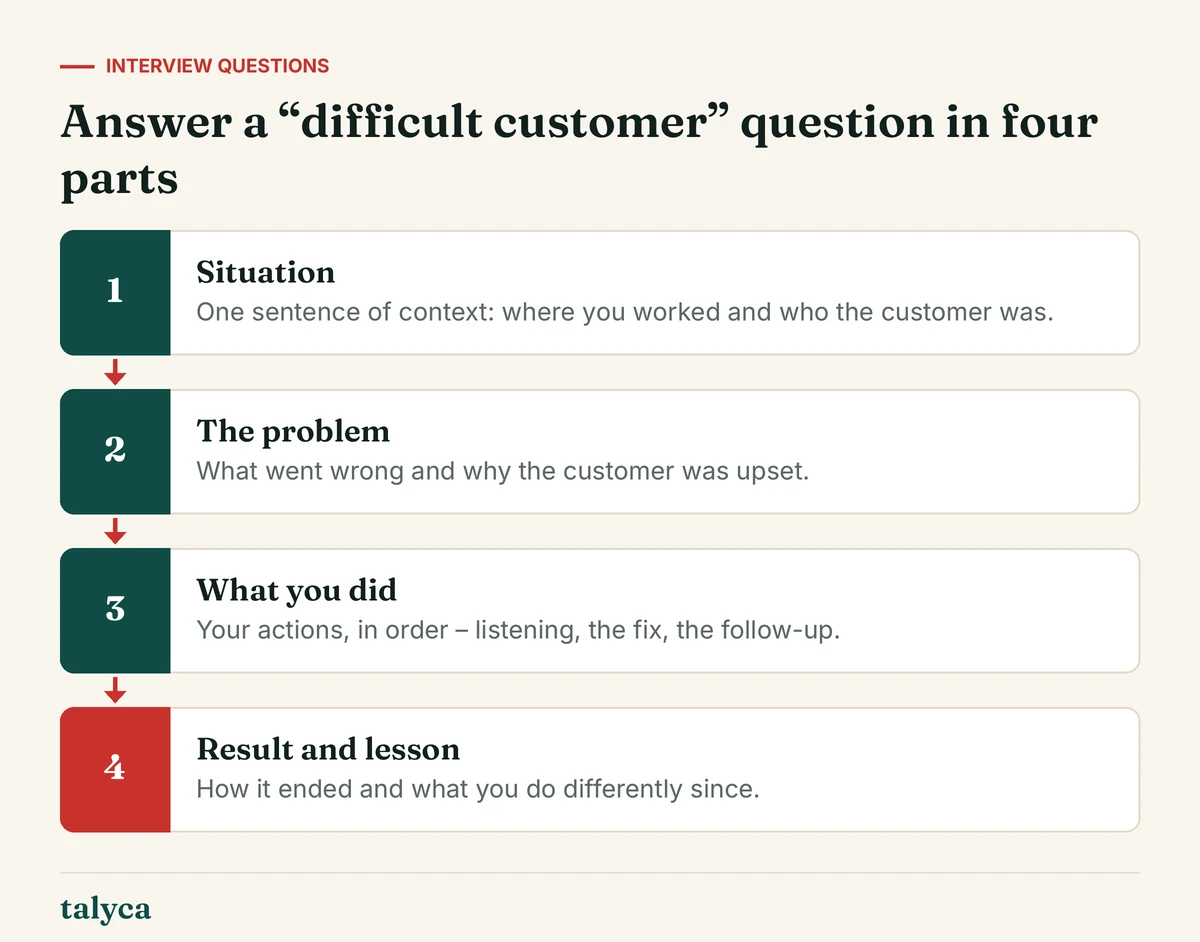
Most questions are behavioural: “Tell me about a time when…”. They’re easier to answer with a simple structure.
Questions about customers
“Tell me about a time you dealt with an upset customer.”
Sample answer: “At the electronics store where I worked, a customer came back with a laptop that had failed twice. He was angry because he’d lost a day of work. I let him explain without interrupting, apologised for the trouble, and checked the warranty while he waited. Instead of a third repair, I got my manager’s approval for an exchange. He left calmer, and since then I always check what options I have before promising anything.”
Why it works: it’s specific, shows listening and ownership, and ends with a lesson.
“What does good customer service mean to you?”
Avoid slogans. Talk about solving the problem on first contact where possible, being honest when you can’t, and following up. One concrete example beats three adjectives.
“How would you handle a customer asking for something against policy?”
Show that you’d explain the reason, offer what you can do, and escalate when appropriate – not simply say no, and not break the rule.
Questions about working remotely
- “Describe your home workspace.” Mention a quiet room, wired internet, a headset, and how you keep customer data private.
- “How do you stay productive at home?” A fixed start time, a set workspace, planned breaks, and checking your queue metrics.
- “What would you do if your internet dropped during a shift?” Tell your lead immediately through the agreed channel, switch to a backup (for example, phone hotspot) if allowed, and document it.
- “How do you ask for help when nobody is next to you?” Search the knowledge base first, then ask a precise question in the team channel.
Questions about skills and tools
Expect questions about typing speed, tools you’ve used (ticketing systems, CRMs, POS systems) and multitasking – especially for chat roles, where you may handle several conversations at once. Be honest about which tools you know; say how quickly you learned the last new one. If the role is bilingual, part of the interview may happen in French – see bilingual customer service jobs.
Tip: keep a short note next to your screen with your three stories and the company’s product in one sentence. In a video interview, glance at it – don’t read from it.
Questions you should ask
At the end you’ll be asked whether you have questions. Good ones for support roles:
- How long is training, and is it paid at the full rate?
- How are schedules set, and how far in advance?
- Which metrics matter most in the first three months?
- What equipment do you provide?
- How does the team communicate during a shift?
Common mistakes
- Speaking badly about former customers or employers.
- Answers that stay general: “I’m a people person.”
- Not testing the video setup – see our video interview tips.
- No questions at the end, which can read as low interest.
For the whole application process, from resume to offer, read applying for remote jobs in Canada.
Common questions
How long should my answers be?
Around one to two minutes for behavioural questions. Use the four-part structure and stop when you’ve given the result.
Is it okay to use an example from outside work?
Yes, if you have little work experience. Volunteering, school projects and helping family members with problems can all show the same skills.
Should I mention salary in the first interview?
Answer if you’re asked, with a range you’ve researched. Otherwise, pay usually comes up with the recruiter or at the offer stage.
More on this topic: our guide Remote Customer Service Jobs in Canada: Phone, Chat and Email Support puts this article in context.