
Bilingual French–English support agents are among the most sought-after remote customer service hires in Canada. This article explains who hires them, how employers test your French and English, how to describe your level honestly, and what the day-to-day work looks like.
Who hires bilingual support agents
Companies that serve customers across Canada need to answer in both official languages, and businesses serving Quebec generally have to provide service in French. That creates steady demand for agents who can switch between languages – in banking and insurance, telecom, e-commerce, software, travel and at outsourcing firms that run support for several brands. Some federally regulated organisations also have their own official-languages obligations.
The work itself is the same as in other support roles, described in our guide to remote customer service jobs in Canada. The difference is that you may be routed customers in either language, or assigned to a French queue that fewer colleagues can cover.
How language tests work
Almost every employer tests bilingual candidates, often in both directions. Expect one or both of the formats below.
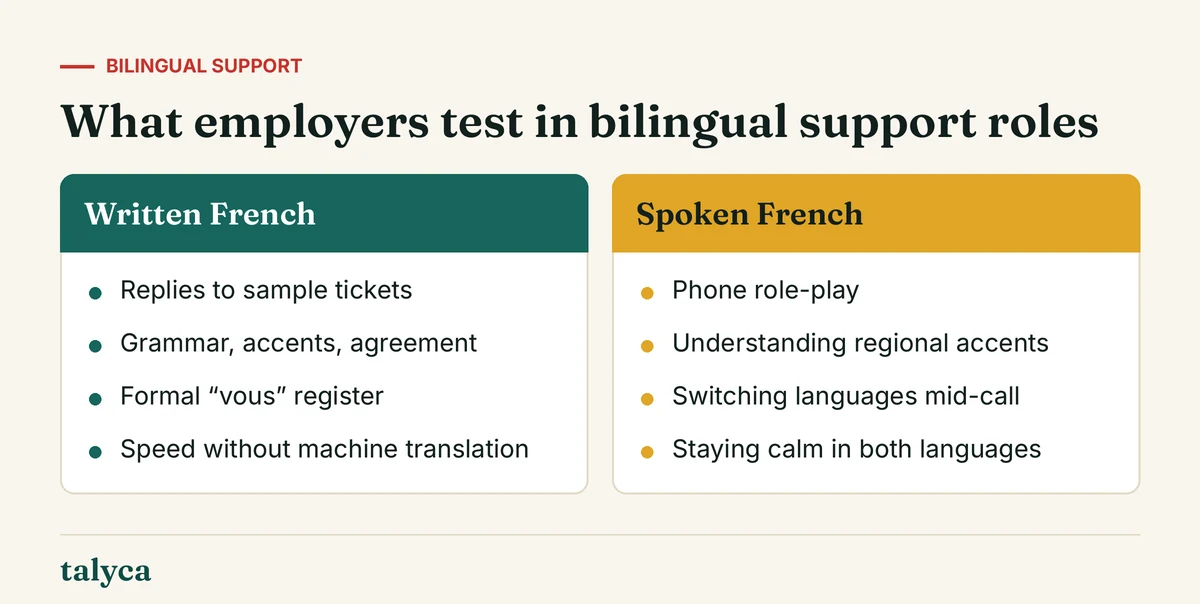
Written tests are often a few customer emails or chats to answer within a time limit. Reviewers look at correct grammar and agreement, accents, a polite register and whether the reply solves the problem. Oral tests are often a short role-play by phone, partly in each language, sometimes with a switch in the middle.
Tip: practise the vocabulary of the industry you apply to – billing, refunds, passwords, delivery, account security – in French and English. Most test scenarios come from everyday support situations.
How to describe your level
Employers need to know whether you can serve a customer in the language without help. Vague labels like “conversational French” lead to awkward surprises in the test. Better:
- Name the level per skill: “French: fluent spoken and written; English: fluent spoken, advanced written.”
- Add evidence: schooling in French, a previous bilingual role, a language certificate (such as DELF/DALF or a federal Second Language Evaluation result if you have one).
- Put it high on your resume: in the profile at the top and in the skills section, not only at the end.
- Be honest: the test will reveal your level anyway, and a candidate who oversold loses credibility.
More on the resume and screening steps in applying for remote jobs in Canada.
What the job is like
Bilingual agents often end up with a mixed queue: part French, part English, depending on volume. A few things are specific to the role:
- Regional differences: customers may speak Quebec, Acadian or European French; you need to understand them all and answer in clear standard French.
- Translation requests from colleagues: you may be asked to check French macros or knowledge-base articles. It’s useful experience, but it should be part of your working time, not extra.
- Peak loads: when fewer agents cover the French queue, it can be busier. Ask how the team handles that.
- Career paths: bilingual agents are well placed for quality assurance, training and team lead roles that cover both language groups.
Pay and the bilingual premium
Many employers pay bilingual agents a higher rate than unilingual agents in the same role, either as a higher base rate or as a separate premium. Not all do – so ask directly in the interview: “Is there a bilingual premium, and how is it paid?” To check whether an overall offer is in a normal range, compare it with the wages listed for customer service representatives on the Government of Canada’s Job Bank.
Before you apply
- Refresh support vocabulary in both languages.
- Prepare two short examples of helping a customer – one in each language.
- Check that your keyboard can type French accents quickly.
- Look at current customer service openings and search for “bilingual” or “French”.
Common questions
Do I need to be perfectly fluent in French?
You need to be able to serve customers in French without help, in writing and usually on the phone. Employers test for that level rather than perfection, but written French must be correct.
Can I apply if my French is from school only?
Yes, if you can hold a support conversation and write clear replies. Be honest about your level and practise with real support scenarios before the test.
Are bilingual support jobs only for people in Quebec?
No. Many employers hire bilingual agents anywhere in Canada, as long as they can work the required hours.
More on this topic: our guide Remote Customer Service Jobs in Canada: Phone, Chat and Email Support puts this article in context.