
An employer of record (EOR) lets a foreign company employ you in Canada without opening a Canadian office: the EOR becomes your legal employer and runs payroll, while the foreign company directs your work. This article explains how the arrangement works, what it means for your pay and rights, and what to check before you sign.
How an employer of record works
A company in the US, Europe or elsewhere that wants to hire you as an employee in Canada would normally need to register here, run Canadian payroll and follow provincial employment law. Many don’t want to do that for a handful of people. Instead, they contract an EOR service that already has a Canadian entity. Our guide to remote jobs in Canada explains how ads signal this; here is the arrangement in detail.
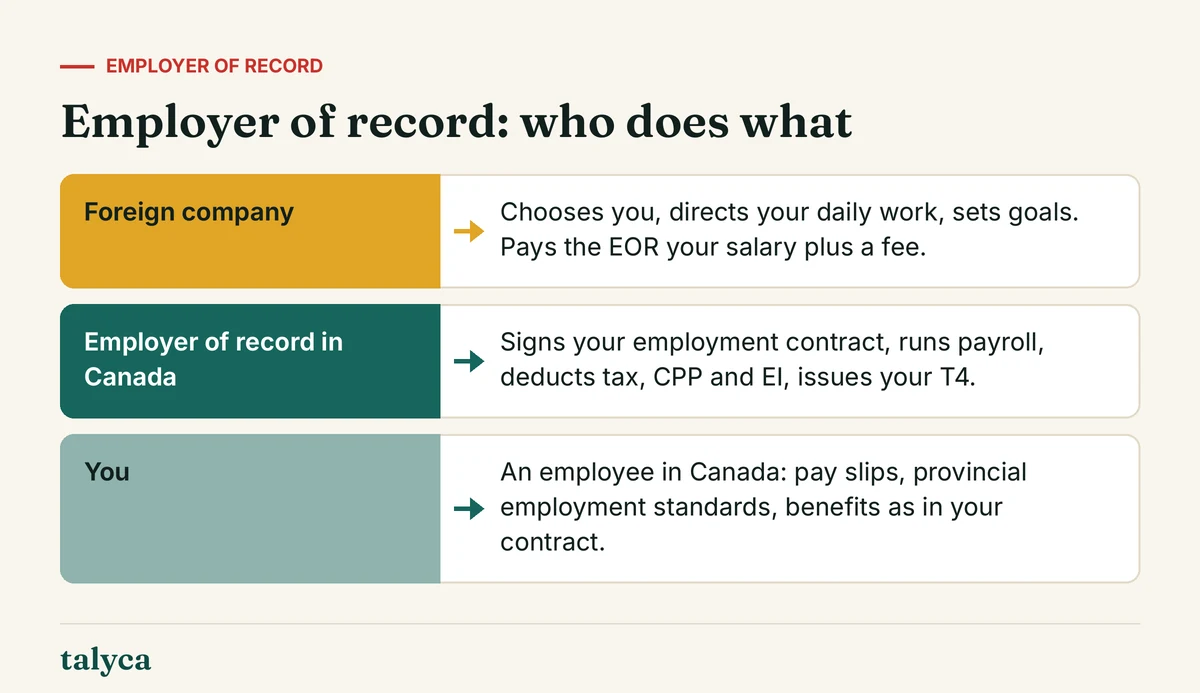
You’ll typically sign an employment contract with the EOR and receive your onboarding from both sides: HR paperwork from the EOR, and laptop, accounts and team introductions from the company you actually work for. Day to day, you’ll hardly notice the EOR – until it’s time for payroll, a benefits question or a problem.
What it means for you
| Topic | With an EOR | As a contractor |
|---|---|---|
| Pay | Salary through Canadian payroll, usually in CAD | You invoice; currency as agreed |
| Deductions | Income tax, CPP and EI withheld | None – you pay tax and both CPP shares yourself |
| Tax slip | T4 from the EOR | You report business income on T2125 |
| Employment standards | Provincial minimums apply (vacation, holidays, notice) | Only your contract |
| Benefits | Whatever the EOR’s plan and your contract include | Your own |
The comparison matters because a US company may offer the choice: “We can hire you through our EOR at X, or as a contractor at Y.” A higher contractor figure often isn’t better once you subtract CPP, benefits and unpaid holidays – see freelancing in Canada for the contractor side.
Salary, benefits and equity
EOR contracts vary more than normal employment contracts, because the foreign company decides what it’s willing to pay for. Common patterns:
- Salary is often set by the company’s own pay bands, sometimes adjusted for Canada. Ask whether it’s quoted in CAD or converted from USD – and if converted, at which point.
- Health and dental benefits come through the EOR’s group plan, if the company pays for one. Don’t assume; ask for the plan summary.
- Retirement matching (for example an RRSP or group RRSP match) is optional – ask whether it is offered.
- Stock options or RSUs are granted by the foreign company, not the EOR. Canadian tax rules for them are complex; get the grant documents and consider professional advice.
Questions to ask before you sign
- Which entity is my legal employer, and in which province is the contract governed?
- What happens to my job if the company ends its contract with the EOR?
- Who approves vacation and handles performance issues – the company or the EOR?
- Which benefits are included, from when, and who do I contact about them?
- Who provides equipment, and who owns it?
- Is any part of my compensation (bonus, equity) paid outside Canadian payroll?
Scam check: real EOR providers are established companies with public websites. An “EOR onboarding” that asks you to pay a fee, buy equipment through a vendor or deposit a cheque is fraud – see remote job scams in Canada.
When the arrangement ends
Because the EOR is your employer, it must follow provincial employment standards if your job ends – including notice or pay in lieu of notice and a Record of Employment for EI. Your contract may promise more than the minimum. If the foreign company simply stops paying the EOR, you still have a claim against your legal employer. Keep copies of your contract, pay slips and any written communications.
Thinking of working for a foreign tech company in particular? Our guide to remote tech jobs compares the three hiring models side by side.
Common questions
Is an employer of record the same as a staffing agency?
They’re similar in that a third party is your legal employer, but an EOR usually employs you only on behalf of one client company and doesn’t find the job for you. The foreign company chooses and manages you.
Do I get EI with an employer of record?
Yes. As an employee on Canadian payroll, EI premiums are deducted, and you can apply for EI benefits if you lose your job and meet the usual conditions.
Can I negotiate with the EOR or only with the company?
Salary and role are negotiated with the company that hires you. Payroll, benefits administration and paperwork questions go to the EOR.
More on this topic: our guide Remote Jobs in Canada: Where to Find Them and How to Get Hired puts this article in context.