
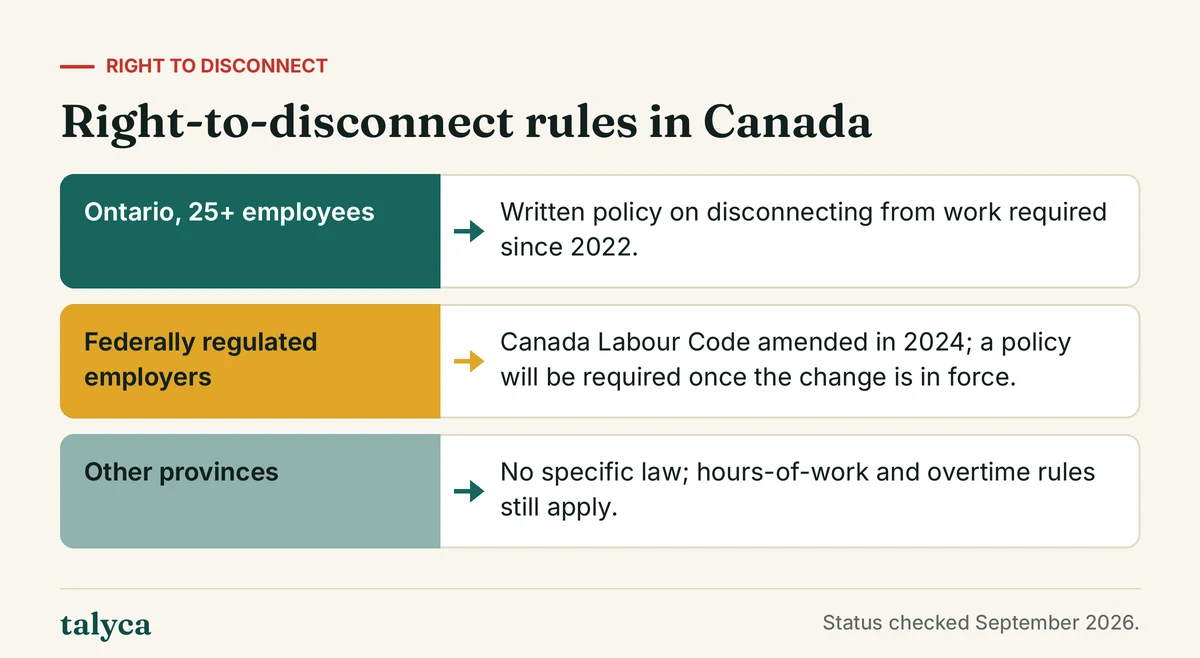
Remote work makes it easy for work messages to follow you into the evening. Canada has no single nationwide “right to disconnect”: Ontario requires larger employers to have a written policy, the federal Canada Labour Code has been amended for federally regulated employers, and elsewhere the ordinary hours-of-work rules apply. This article explains what that means for you.
The rules at a glance
A right to disconnect means that employees shouldn’t be expected to answer work communications outside working hours, except in defined situations. How that’s handled depends on which law governs your job – usually the province where you work, or the Canada Labour Code if your employer is federally regulated. Our guide to working from home in Canada explains how to tell which applies.
Ontario: a written disconnecting policy
Since 2022, Ontario employers with 25 or more employees on January 1 of a year must have a written policy on disconnecting from work for all employees in Ontario, and give employees a copy. The law defines disconnecting from work as not engaging in work-related communications – emails, calls, video calls, messages – so as to be free from the performance of work.
Important to understand: the law requires a policy, but doesn’t set its content. It doesn’t create a new ban on after-hours contact. What the policy says – for example, that nobody is expected to reply to email after 6 p.m. except on call – is up to the employer. Ontario also requires employers of that size to have a written policy on electronic monitoring of employees.
Federally regulated employers
For employers under the Canada Labour Code – such as banks, telecommunications companies, airlines and interprovincial transport – Parliament amended the Code in 2024 to require a disconnecting-from-work policy covering work-related communications outside scheduled hours. When we checked in September 2026, the change depended on its coming into force and supporting regulations; once in force, employers have a period to put a policy in place. Check the current status on the Government of Canada’s Labour Program pages.
Other provinces and territories
Other provinces and territories don’t have a specific right-to-disconnect law. That doesn’t leave you without protection: employment standards on hours of work, overtime, rest periods and pay apply everywhere. If your employer requires you to answer messages in the evening, that time is generally working time and has to be paid, including as overtime where thresholds are exceeded.
No legal advice: this is a general overview (checked September 2026). For a specific situation, contact your provincial employment standards office or the federal Labour Program.
What you can do in practice
- Ask for the policy if your employer is covered, and read what it says about exceptions such as on-call duty.
- Agree expectations in writing: working hours in your time zone, response times, on-call arrangements and how they’re paid.
- Use your tools: status messages, notification schedules, scheduled sending for your own late emails so you don’t create pressure on others.
- Record extra time if you’re asked to work outside your hours, so it can be paid or compensated.
- Talk to your manager early if after-hours contact becomes routine rather than exceptional.
Across time zones the line gets blurrier – our article on working across Canadian time zones has practical tips for distributed teams.
Common questions
Can I be disciplined for not answering emails after hours?
It depends on your contract, role and the rules that apply. If you’re not on call and not expected to work after hours, a disconnecting policy and hours-of-work rules generally support you; if in doubt, ask your employment standards office.
Does the Ontario policy apply if my employer is in another province?
The Ontario requirement covers employees in Ontario of employers with 25 or more employees in Ontario. If you work in another province, that province’s rules usually apply.
Are managers covered?
Ontario requires the policy for all employees, though its content may differ by role. Many managers are exempt from overtime rules, which is worth checking in your province.
More on this topic: our guide Working From Home in Canada: Your Rights, Home Office Expenses and Taxes puts this article in context.