
As a freelancer or contractor, nobody withholds tax from your income. Once the amount you owe at tax time gets large enough, the CRA expects you to pay during the year in quarterly instalments. This article explains when instalments apply, the due dates, the three ways to calculate them, and a simple system for setting money aside.
When you have to pay instalments
Employees rarely deal with instalments because their employer deducts tax from each paycheque. Self-employed people – see our guide to freelancing in Canada – pay tax and CPP when they file, unless instalments are required.
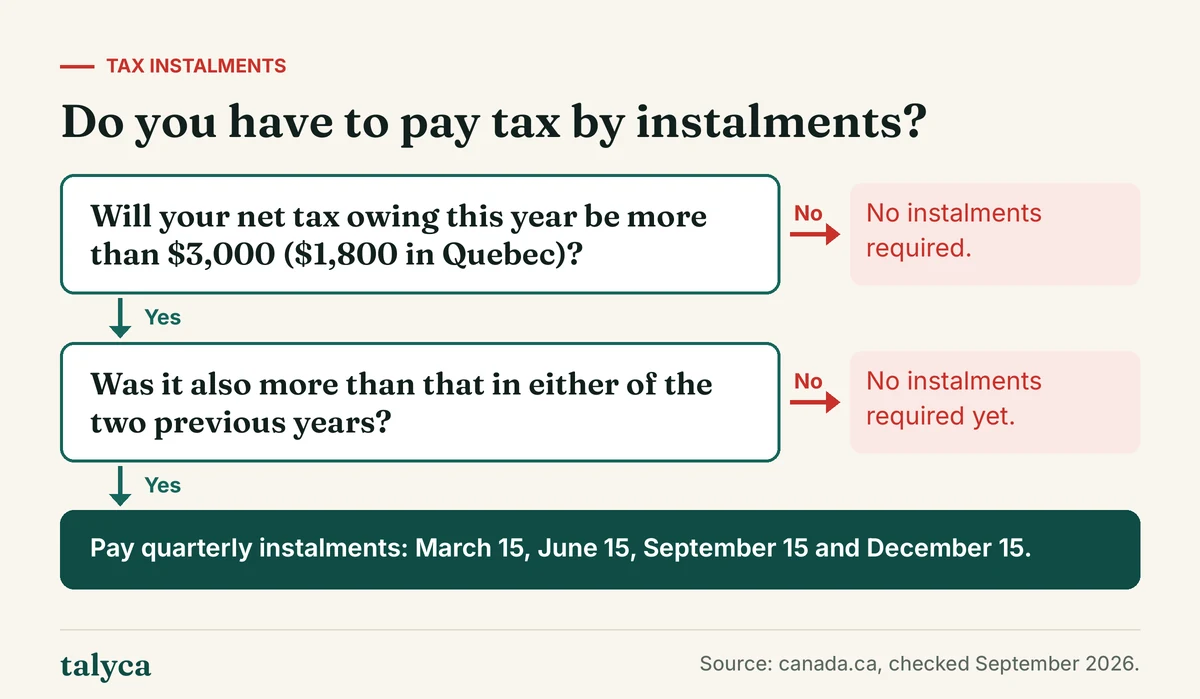
In practice, the first year of freelancing often has no instalment requirement, because the test looks back at previous years. That doesn’t mean the tax disappears: you’ll owe it all at once when you file. Many new freelancers get caught by this in their second spring.
Due dates
| Instalment | Due date |
|---|---|
| 1st | March 15 |
| 2nd | June 15 |
| 3rd | September 15 |
| 4th | December 15 |
If a due date falls on a weekend or public holiday, the payment is considered on time if received on the next business day. Separately, self-employed individuals have until June 15 to file their return, but any balance owing is still due by April 30.
Three ways to calculate them
- No-calculation option: pay the amounts on the instalment reminders the CRA sends you. If you pay those amounts on time, you won’t be charged instalment interest, even if they turn out too low.
- Prior-year option: base all four payments on last year’s net tax owing. Useful if your income is stable or falling.
- Current-year option: estimate this year’s tax and pay a quarter each time. Useful if income drops sharply – but if you underestimate, interest can apply.
Late or insufficient instalments are charged interest, and an additional penalty can apply when the interest is large. The CRA reminder is the simplest safe choice for most people.
No tax advice: this summarises the CRA’s published rules (checked September 2026). For your own calculation, use your CRA My Account, the instalment reminders, or an accountant.
A simple system for setting money aside
- Open a separate savings account just for tax.
- Move a fixed percentage of every payment you receive into it on the day it arrives. Pick a percentage that covers income tax and both CPP shares at your expected income; adjust after your first return.
- If you’re GST/HST-registered, move the tax you charged too – it was never your money.
- Pay instalments from that account on the due dates, and your final balance in April.
With this habit, instalments stop being a shock and become a routine transfer four times a year. Clear invoicing makes it easier to track what came in – see how to invoice as a freelancer.
Job plus freelance income
If you have a job and freelance on the side, your employer withholds tax on your salary only. The freelance income can push your net tax owing over the threshold. Some people ask their employer to withhold extra tax from their pay (using form TD1) instead of paying instalments – an option worth considering if your side income is steady.
Working for a foreign company as an employee through an employer of record? Then Canadian payroll handles your tax – see employer of record explained.
Common questions
Do I pay instalments in my first year of freelancing?
Usually not, because the test looks at previous years. But you’ll owe the full year’s tax when you file, so set money aside anyway.
How do I pay an instalment?
Through your bank’s online bill payment (payee: CRA), CRA My Payment, or other options listed on canada.ca. Use your SIN as the account number for individual instalments.
What happens if I miss an instalment?
The CRA charges instalment interest on late or insufficient payments. Paying the next instalments early or larger can reduce the interest.
More on this topic: our guide Freelancing in Canada: Contracts, GST/HST and Taxes for Remote Work puts this article in context.