
If your employer requires you to work from home, you may be able to deduct part of your home costs – but only with the detailed method, a signed form T2200, and a calculation that holds up. This article walks through the calculation step by step, with a worked example, and lists what salaried employees can and can’t claim.
First: are you eligible?
Before calculating anything, check the three conditions: your employer required you to work from home, the work space meets the “more than 50% of the time for at least four consecutive weeks” or “exclusive and regular meetings” test, and your employer completes form T2200. The conditions and the overall rules are explained in our guide to working from home in Canada: rights and taxes. The flat-rate method used for 2020–2022 no longer exists.
The calculation, step by step
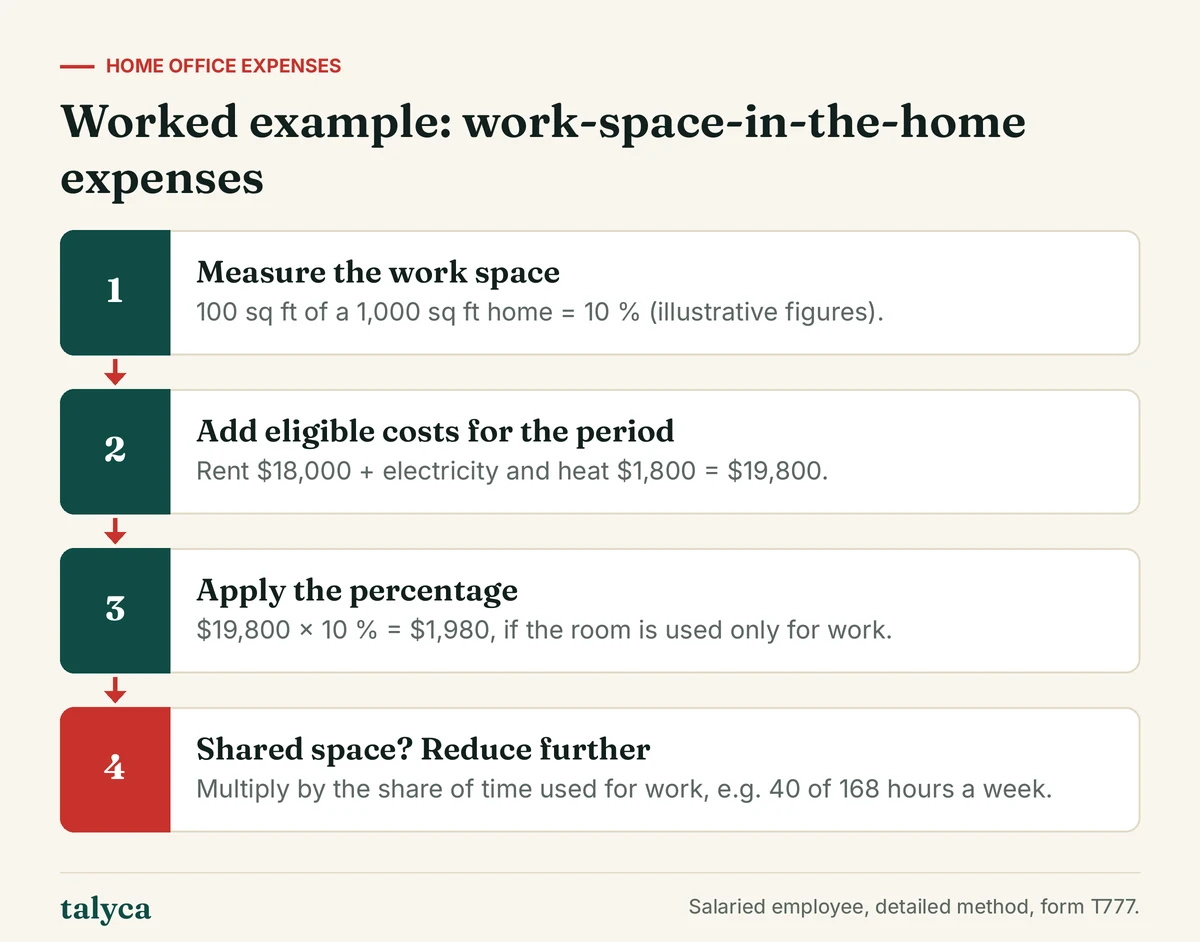
1. Measure the work space
Divide the area of your work space by the total finished area of your home (including hallways, bathrooms and kitchen). A 100 sq ft room in a 1,000 sq ft apartment gives 10%. Use a reasonable basis and keep a note of how you measured.
2. Add up eligible expenses
For the period you worked from home, add the eligible costs you actually paid: for salaried employees typically rent, electricity, heating, water, maintenance and minor repairs. Monthly home internet fees are handled separately – you claim the work-use portion, based on a reasonable estimate of your employment use.
3. Apply the percentage
Multiply the eligible expenses by the work-space percentage. If the room is used exclusively for work, that’s your amount.
4. Shared space: reduce by time used
If the space is also used for personal purposes – a corner of the living room – also multiply by the share of time it’s used for work. For example, 40 hours of work per week out of 168 hours in a week.
Worked example: shared space
| Step | Calculation | Result |
|---|---|---|
| Area share | 150 sq ft ÷ 1,200 sq ft | 12.5% |
| Eligible costs (rent + utilities) | $21,600 + $2,100 | $23,700 |
| Area portion | $23,700 × 12.5% | $2,962.50 |
| Time share (shared space) | 40 ÷ 168 hours | 23.8% |
| Deductible amount | $2,962.50 × 23.8% | about $705 |
Illustrative figures for a salaried employee who worked from home all year. Reduce them for any months you worked in the office, and subtract any amount your employer reimbursed.
What salaried employees can and can’t claim
- Yes: rent, electricity, heat, water, utilities portion of condo fees, maintenance and minor repairs, monthly home internet access fees (work-use portion).
- Only commission employees: home insurance and property taxes.
- No: mortgage interest, mortgage principal, capital cost allowance, furniture, computers and other equipment, internet connection or installation fees.
Home office expenses can’t create or increase a loss from employment. If your amount is higher than your employment income allows, the excess can be carried forward to the next year.
Forms and records
- T2200 – completed and signed by your employer. You don’t file it, but you must keep it.
- T777 – where you calculate and claim the expenses with your return.
- Receipts and bills for every amount, plus your measurement notes.
No tax advice: this follows the CRA’s published guidance for employees (checked September 2026). Self-employed people claim business-use-of-home expenses differently, on form T2125 – see freelancing in Canada.
Common questions
Can I claim home office expenses if I work from home only part of the week?
Yes, if the work space was where you worked more than 50% of the time for at least four consecutive weeks, and the other conditions are met. The amount is limited to the period you worked from home.
Do I need to send the T2200 to the CRA?
No. Keep the signed T2200 and your receipts in case the CRA asks for them.
Can I claim my laptop or desk?
Not as a salaried employee. Computers, furniture and other equipment aren’t deductible; ask your employer about providing or reimbursing them.
More on this topic: our guide Working From Home in Canada: Your Rights, Home Office Expenses and Taxes puts this article in context.