Customer service is one of the most common ways into remote work in Canada: companies hire agents to answer phone calls, chats and emails from home. This guide explains how the three channels differ, what employers ask for, which home setup you need, how pay and schedules work, and how to get through the hiring process.
What a remote customer service job involves
A remote support agent does the same work as an agent in a contact centre – answering questions, fixing account problems, processing returns, calming frustrated customers – but logs in from home. You work inside the company’s systems: a ticketing or contact-centre tool, a knowledge base with approved answers, and usually an internal chat to reach your team lead.
Job titles vary. Look for customer service representative, customer support specialist, customer care agent, technical support agent, customer success associate and, for more senior roles, customer success manager. “Tier 1” means first contact and common questions; “Tier 2” handles cases that Tier 1 escalates.
Employers include software companies, online shops, telecom and utility providers, banks and insurers, travel companies and outsourcing firms that run support for other brands. Outsourcers hire in larger numbers and often train from scratch, which makes them a realistic first step.
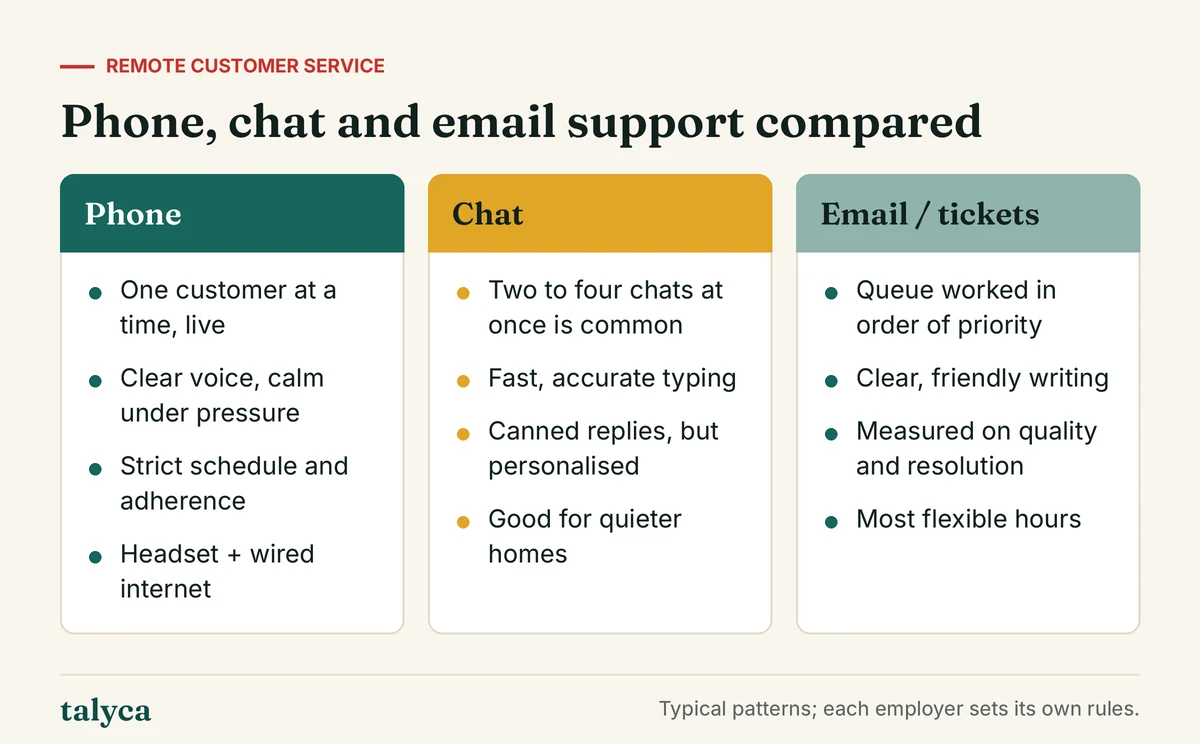
Phone, chat and email support compared
Most roles focus on one or two channels, and they suit different people. If you type fast but dislike surprise conversations, chat or email is a better fit than phone; if you calm people easily with your voice, phone roles are often easier to get.
How performance is measured
Support work is measured closely, and job ads often mention the metrics. Knowing them helps in the interview:
- CSAT (customer satisfaction): the rating customers give after a contact.
- First contact resolution: share of issues solved without a follow-up.
- Handle time or response time: how long a contact takes, or how quickly you answer.
- Schedule adherence: whether you are logged in and available when your schedule says so. It matters most in phone roles.
- Quality score: a reviewer checks sample contacts against a checklist – correct information, tone, following the process.
Skills and languages employers ask for
Most entry-level support jobs ask for a high school diploma, some customer-facing experience (retail and hospitality count), and good computer skills. Beyond that, ads typically look for:
- Clear written English for chat and email; employers often test this with sample replies.
- Typing speed and accuracy – some ads name a minimum words-per-minute rate.
- Problem solving: finding the answer in a knowledge base and following a process without skipping steps.
- Tools such as Zendesk, Salesforce Service Cloud, Freshdesk, Intercom or Gorgias. You don’t need to know them all; naming one you have used helps.
- Composure: a steady tone with upset customers is a skill employers screen for in interviews.
Bilingual roles: French–English support is in steady demand, because many companies must or want to serve customers in both official languages. If you speak both well, put it at the top of your resume and say which level you have in each. Some employers test both languages.
The home setup you need
Employers of remote agents are strict about the workspace, because call quality and data protection depend on it. The requirements below appear in many ads; the red flags on the right are signs of a scam, not a real employer.
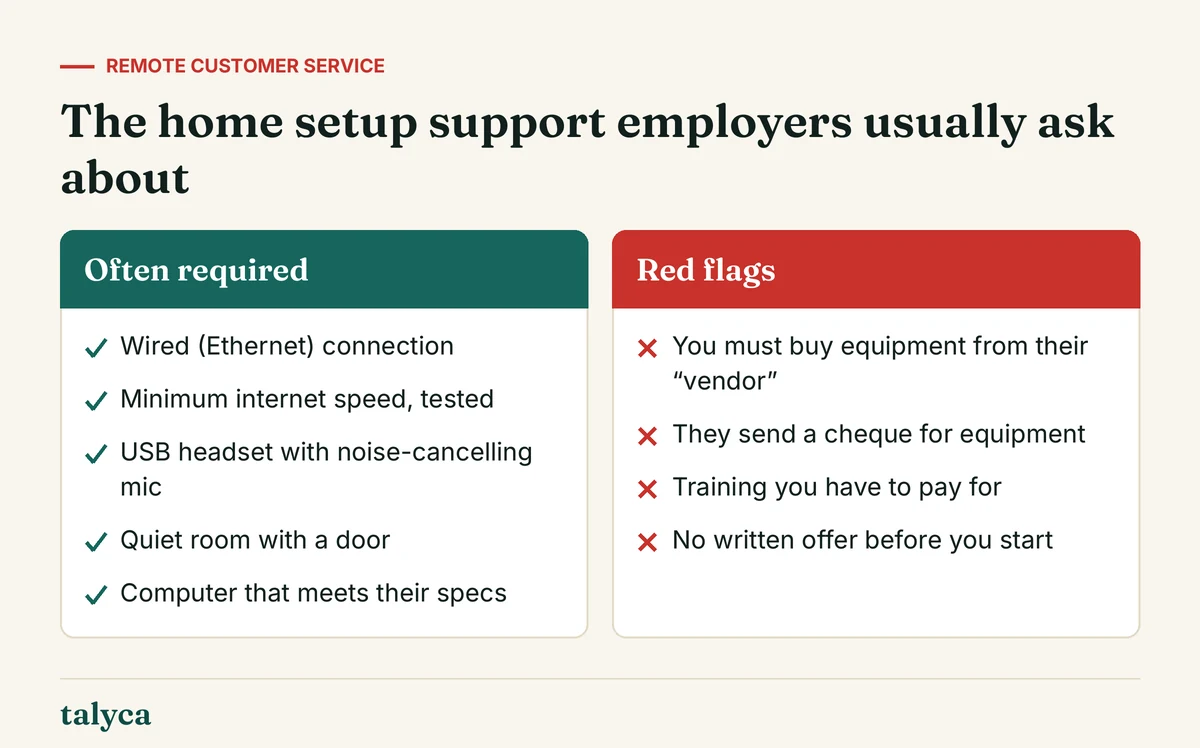
Test your internet before you apply: many employers name a minimum download and upload speed and ask for a wired connection because Wi-Fi drops calls. You may also need a room with a door, since conversations can include personal and payment data. If the company provides a laptop, it will usually be locked down and must be returned when you leave.
Some employers pay an internet or equipment allowance; others expect you to have the basics. If you are an employee and your employer requires you to work from home, you may be able to deduct some costs – see working from home in Canada: rights and taxes.
Pay, schedules and contracts
Most remote support agents in Canada are paid hourly. Entry-level rates are generally at or somewhat above the minimum wage of your province, with higher rates for bilingual, technical and Tier 2 roles. To check whether an offer is fair, look up the occupation “customer service representatives” in the wage section of the Government of Canada’s Job Bank, which lists pay ranges by region.
Schedules depend on the channel. Phone and chat queues follow customer demand, so evenings, weekends and holidays are common, especially at outsourcers and in retail or travel. Email support is more flexible. Ask in the interview:
- Are shifts fixed or do they change every week, and how far in advance is the schedule published?
- Which time zone are the shifts in?
- Is paid training full-time for the first weeks, and at what rate?
- Are breaks scheduled, and how is overtime handled?
- Is the role permanent, a fixed-term contract, or seasonal (for example, only before the holidays)?
Training must be paid: as an employee, time spent in mandatory training is working time. An “employer” who asks you to pay for training or a starter kit is almost certainly running a scam – see remote job scams in Canada.
How to get hired
Support hiring is often fast and follows a pattern: an online application with screening questions, an assessment (typing test, writing sample, or a simulated chat), a phone or video interview, and a background check. To stand out:
- Translate your experience. “Served customers at the till” becomes “Handled 80+ customer interactions per shift, including returns and complaints”. Only use numbers that are true.
- Name your tools – POS systems, ticket tools, CRMs, Google Workspace or Microsoft 365.
- Write screening answers like a support reply: short, friendly, error-free. That’s what they’re testing.
- Prepare two stories: a difficult customer you calmed down, and a problem you solved by following or improving a process.
- Test your setup before the video interview; phone roles may judge your audio quality too.
Our guide to applying for remote jobs covers the Canadian resume format and common interview questions. If you have no work experience at all, start with entry-level remote jobs. Current openings are in the customer service category.
Go deeper on this topic:
- Bilingual Customer Service Jobs in Canada: French–English Support From Home – Remote French–English support roles.
- Customer Service Interview Questions for Remote Jobs – With Sample Answers – Common interview questions for remote support roles, how to structure your answers and sample answers you can adapt – without clichés.
Common questions about remote customer service jobs
Can I do remote customer service without experience?
Yes. Outsourcing companies and large brands regularly hire agents without support experience and train them. Retail, hospitality or volunteer work counts as customer-facing experience – describe it with concrete tasks.
Do I need to speak French?
Not for most roles, but bilingual English–French agents are sought after, especially by companies serving Quebec, and the roles often pay more. Be honest about your level: many employers test it.
Can I work remote customer service part-time?
Part-time and seasonal roles exist, especially before the holidays and in travel. They usually still require fixed shifts, so you’ll need to be reliably available at the scheduled times.
Do I have to buy my own equipment?
It depends on the employer. Many ship a laptop and headset; others expect you to provide a computer and headset that meet their specifications. You should never pay the employer or their “vendor” for equipment.
Is chat support easier than phone support?
Different rather than easier. Chat agents often handle several conversations at once and need fast, accurate typing; phone agents handle one customer at a time but have no time to think before answering.