
A clear invoice gets you paid faster and keeps your records ready for tax time. This article shows what a Canadian freelance invoice should contain, when and how to show GST/HST, which payment terms work, and how to handle foreign clients and late payers.
What an invoice should include
There’s no single mandatory template for freelancers who aren’t registered for GST/HST, but a professional invoice answers every question a client’s accounts team might have. The basics of freelancing – registration, CPP and taxes – are in our guide to freelancing in Canada; here is the invoice itself.
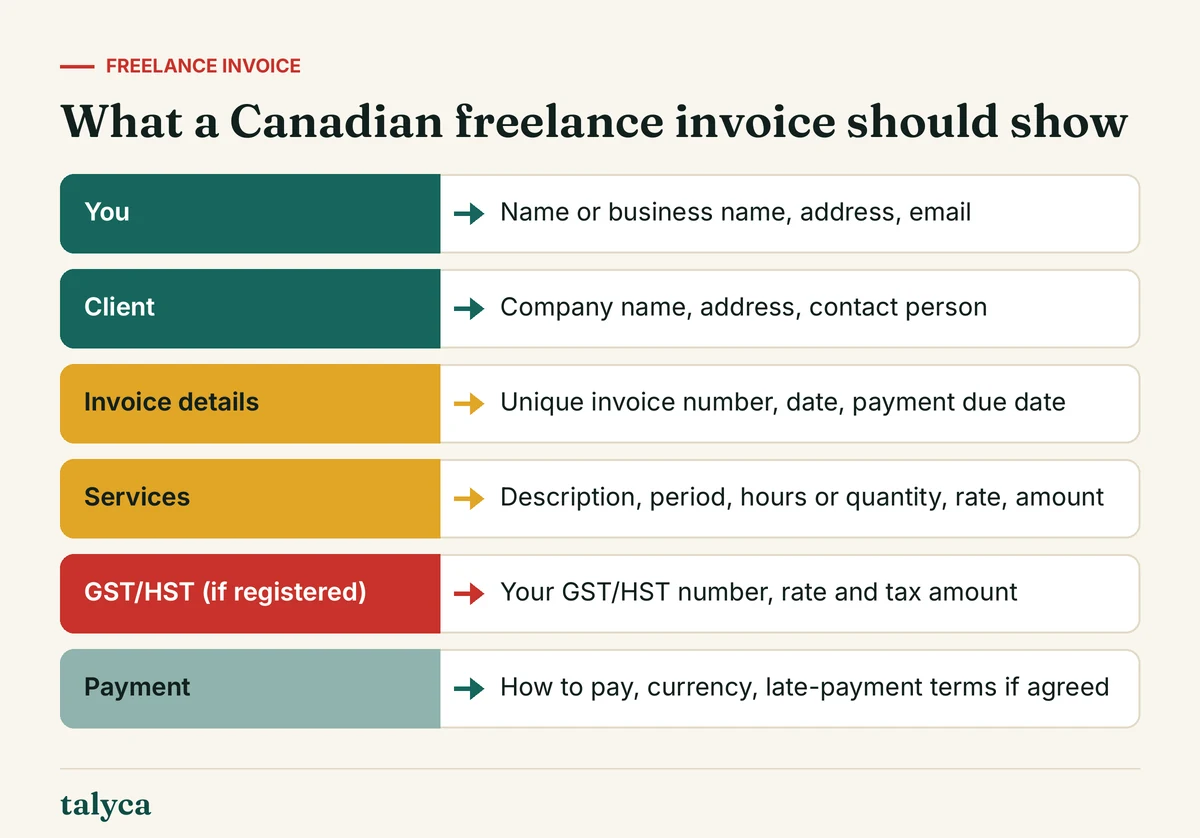
Number invoices sequentially (for example, 2026-001, 2026-002) and never reuse a number. It keeps your records clean and makes it easy to match payments to invoices.
GST/HST on your invoices
If you are a small supplier and not registered, don’t charge GST/HST and don’t show a GST/HST number. Once you’re registered, the CRA requires certain information on invoices, and the required details increase with the amount of the sale. For larger invoices this includes your business name, the invoice date, your GST/HST registration number, the total amount, the tax charged (or the rate if the price includes tax), the client’s name, and a description of the services. The exact thresholds and requirements are listed on canada.ca under “input tax credit information requirements” – check them when you register.
Which rate? The GST/HST rate depends on where the supply is made – broadly, where your client is located – not where you live. Services to clients outside Canada are often zero-rated, but show them on your invoice and in your records. The CRA explains the place-of-supply rules in detail.
Payment terms that work
- Agree terms in the contract, then repeat them on the invoice: “Payment due within 14 days.”
- Use a due date, not just “Net 30” – “Due by October 31, 2026” is harder to overlook.
- Deposits for projects: asking for a part up front (for example, for a new client or a large project) reduces risk.
- Milestones: for longer work, invoice at agreed stages rather than once at the end.
- Late fees: only charge them if they were agreed in advance.
Foreign clients and currency
For clients abroad, state the currency explicitly (“USD 2,400.00”) and agree who pays transfer fees. Bank wires, payment platforms and multi-currency accounts differ considerably in fees and exchange rates, so compare before your first large payment. Keep a record of the Canadian-dollar amount you actually received: you report income in Canadian dollars. US clients often ask for form W-8BEN to document that you’re not a US person – that’s normal and not an invoice item.
Overpayment scam: a “client” who pays too much by cheque or transfer and asks you to refund the difference is running a classic fraud. Wait until funds have truly cleared and never forward money – see remote job scams.
When a client pays late
- Friendly reminder a day or two after the due date, with the invoice attached.
- Second reminder a week later, with a clear new date.
- Phone call or message to your contact – sometimes the invoice is simply stuck in approval.
- Pause further work if your contract allows, and say so politely.
- Formal demand and, for amounts within the limit, small claims court in your province as a last resort.
Records for tax time
Keep copies of every invoice, the matching payment and any related expenses. You’ll need them for your T2125 and, if registered, your GST/HST returns. Setting aside a share of each payment for tax makes quarterly instalments painless – see tax instalments for the self-employed.
Common questions
Do I need special software to invoice?
No. A clean template in a word processor or spreadsheet works. Invoicing or accounting software helps once you have several clients or are GST/HST-registered.
Can I invoice in US dollars?
Yes, if agreed with the client. Record the Canadian-dollar amount you receive for your income tax records.
What payment terms are common?
Fourteen or thirty days are common. Whatever you choose, put it in your contract and on every invoice as a specific due date.
More on this topic: our guide Freelancing in Canada: Contracts, GST/HST and Taxes for Remote Work puts this article in context.