
Canada spans six time zones, so a remote job with “Eastern Time hours” starts at 6 a.m. in Vancouver and ends at 6:30 p.m. in St. John’s. This article shows what common shift patterns mean where you live, which questions to ask before you accept, and how to work well with teams in other countries.
Six time zones, one job ad
Most Canadian employers with national teams schedule around Eastern Time, because head offices in Toronto, Ottawa and Montreal set the rhythm. US employers often use Eastern or Pacific Time. When a job ad says “must be available during EST business hours”, that sounds harmless – until you translate it into your own clock. Our guide to remote jobs in Canada explains how to read the rest of the location line; this article is about the hours.
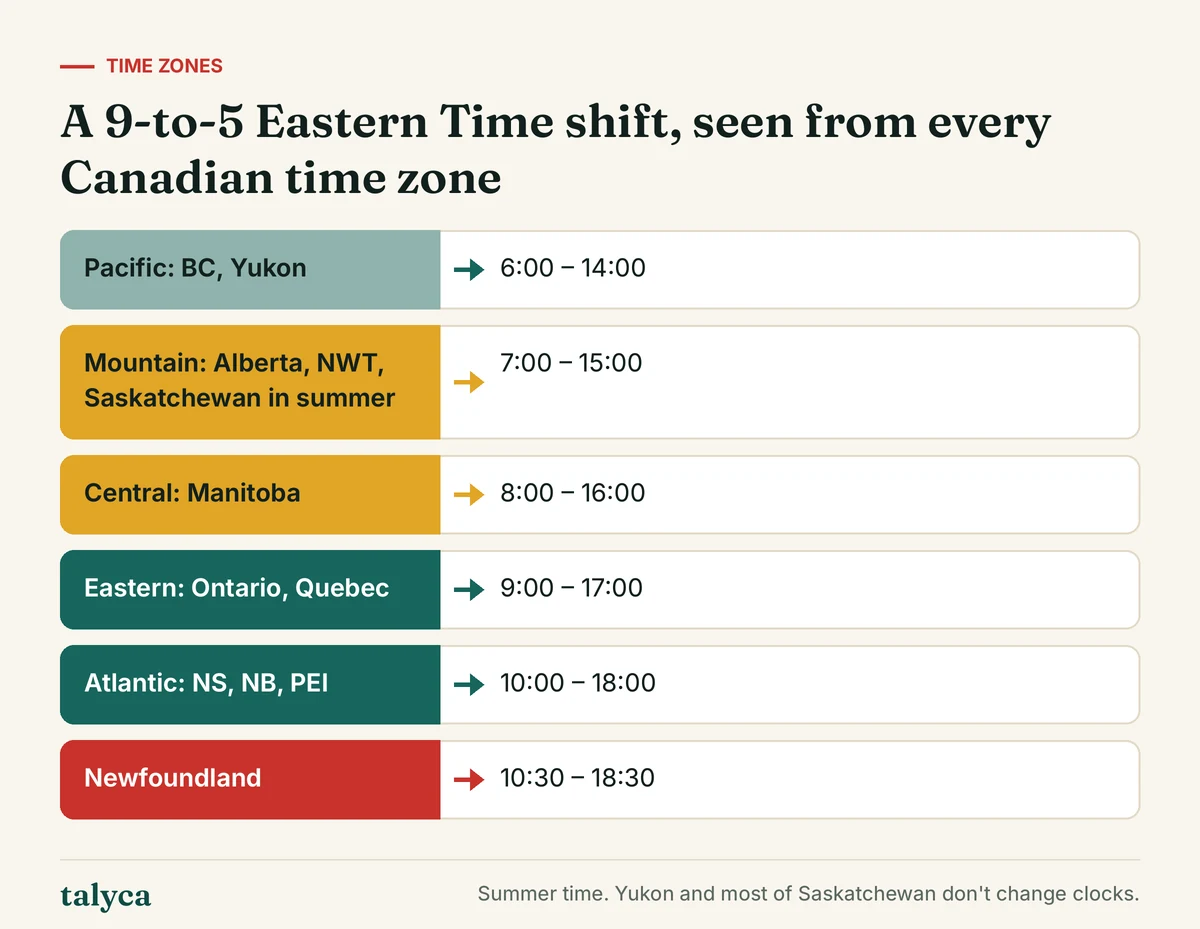
Two details catch people out. Yukon stays on the same time all year, and so does most of Saskatchewan – which means their offset to Eastern Time changes when the rest of the country switches clocks in March and November. Newfoundland is 30 minutes ahead of Atlantic Time, so meeting invitations created in other zones often land at odd half-hours.
Common shift patterns in remote job ads
| What the ad says | What it usually means | Ask about |
|---|---|---|
| “Eastern business hours” | Roughly 9:00–17:00 ET, fixed | Exact start time, lunch break, flexibility |
| “Core hours 11–3 ET” | You must be online in that window; the rest is flexible | Meeting load outside core hours |
| “Rotating shifts” | Schedule changes weekly or monthly | How far ahead schedules are published |
| “Coverage until 8 p.m. PT” | Late shifts for people further east | Shift premium, how late shifts are shared |
| “Async-first” | Most work is written and done at your own time | Required overlap, response-time expectations |
For customer support roles, where queues follow customer demand, shifts are usually stricter; our guide to remote customer service jobs covers typical schedules there.
If you live in the West
An Eastern-hours job from British Columbia means starting at 6:00 in summer. Some people love finishing at 14:00; others find it unsustainable after a few months. Before you accept, be honest with yourself about your mornings – and ask whether the employer lets West Coast staff shift their day later. Many do, provided you cover a core window.
The reverse applies for US West Coast employers: a Pacific-hours job from Halifax runs until 21:00 local time. Also check where holidays fall: a US employer may expect you to work on Canadian statutory holidays unless your contract or provincial employment standards say otherwise.
Working with teams in other countries
Teams spread across continents rely on a few shared hours and a lot of writing. Practical habits that make it work:
- Put your time zone in your profile and email signature, and write times with the zone: “14:00 ET / 11:00 PT”.
- Protect the overlap for conversations that need everyone; move status updates into writing.
- Write hand-offs at the end of your day so a colleague in Europe or Asia can continue without waiting for you.
- Use scheduling tools that show everyone’s local time when you propose meetings.
- Agree on response times: “same business day” is realistic across zones, “within the hour” usually isn’t.
Hours, overtime and pay
Time zones don’t change your rights. If you are an employee, the hours-of-work and overtime rules of the jurisdiction that governs your job apply to the hours you actually work, wherever the team is. Regular meetings outside your shift are working time. Split shifts – two hours early for a European call and two hours late for a Pacific one – should be agreed, not assumed. The details are in our guide to working from home: rights and taxes, and our article on the right to disconnect covers after-hours messages.
Before you sign: ask for your working hours in your own time zone in writing, plus how often you’d attend meetings outside them. It avoids the most common remote-work misunderstanding.
Questions to ask in the interview
- Which time zone are the team’s core hours in, and what are they?
- Can I set my working day within a range, or is the start time fixed?
- How many recurring meetings fall outside core hours, and are they rotated between zones?
- Do shifts or schedules change, and how far in advance are they published?
- Which holiday calendar applies to me?
Asking these questions signals that you take remote work seriously – employers generally see it as a good sign, not as difficulty.
Common questions
Which time zone do most Canadian remote jobs use?
Eastern Time is the most common reference for national employers, because many head offices are in Ontario and Quebec. US employers often use Eastern or Pacific Time. The job ad or the recruiter can tell you.
Can I ask to work different hours than the team?
Yes, and many employers agree as long as you cover a core window of overlap. Ask during the interview and get the agreed hours in writing.
Are early or late shifts paid more?
Only if your contract or collective agreement provides a shift premium. Employment standards don’t generally require one, but overtime rules still apply to extra hours.
More on this topic: our guide Remote Jobs in Canada: Where to Find Them and How to Get Hired puts this article in context.