Working from home doesn’t change your basic rights as an employee in Canada – but it raises new questions about hours, overtime, equipment, monitoring and tax deductions. This guide explains which rules apply to you, what your employer owes you, how the home office deduction with form T2200 works, and what changes when your employer is outside Canada.
Which rules apply to you
Employment law in Canada is split between the federal government and the provinces and territories. Workers in federally regulated sectors are covered by the Canada Labour Code; everyone else falls under the employment standards of a province or territory. For remote workers, that is usually the province where they actually work – which is often where they live.
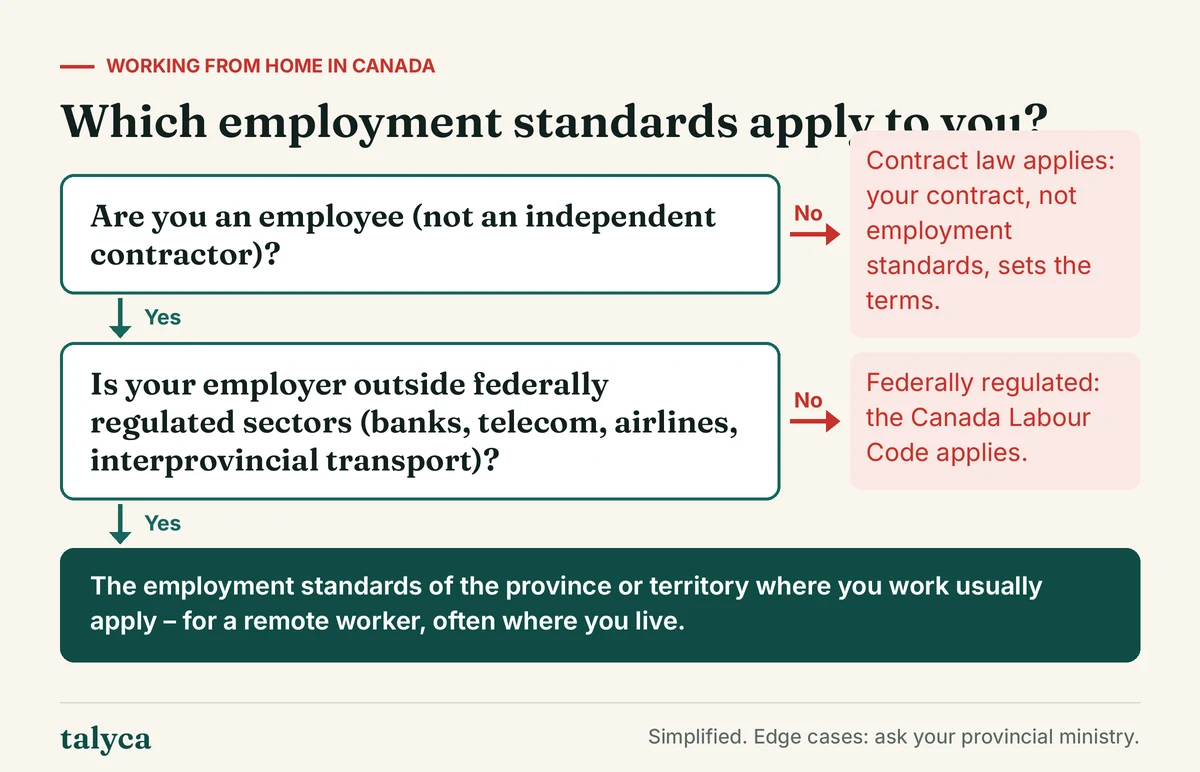
Employment standards set minimums – minimum wage, hours and overtime, vacation and statutory holidays, leaves, and notice of termination. Your contract can give you more, but not less. These rules apply to employees working from home just as they do in the office.
Contractors are different: if you are genuinely self-employed, employment standards don’t apply and your contract governs the relationship. See freelancing in Canada.
Hours, overtime and being reachable
Remote work blurs the line between working time and personal time, but the law still counts working time. A few principles apply across Canada:
- Time worked is paid, including mandatory training, team meetings and required tasks outside your shift.
- Overtime starts after a set number of hours – for example, after 44 hours per week in Ontario, or after 8 hours per day and 40 per week in some other provinces and under the Canada Labour Code. Some jobs are exempt; check your province.
- Breaks and rest periods apply at home too, such as an eating break after a certain number of hours.
- Answering emails after hours can count as work if your employer requires or expects it.
Some provinces have added rules specific to digital work. In Ontario, employers with 25 or more employees must have a written policy on disconnecting from work and a written policy on electronic monitoring that explains how and why employees are monitored. Ask your employer for these policies if they apply.
Minimum wage applies to remote employees at the rate of the jurisdiction that governs their job. The federal minimum wage for federally regulated employers is $18.15 per hour since April 1, 2026; provincial rates differ and most are adjusted once a year.
Equipment, costs and your workspace
There is no general Canadian rule that obliges employers to pay for a home office. What you get depends on your contract and employer policy. In practice, many employers provide a laptop and sometimes a monitor and headset, and some pay a monthly allowance for internet or phone.
- Get it in writing: which equipment is provided, who owns it, whether you may use it privately, and how it is returned.
- Deductions from pay for lost or damaged equipment are restricted by employment standards in most provinces; an employer generally can’t simply deduct the cost from your wages.
- Health and safety: occupational health and safety laws generally extend to a home workplace. Employers may ask you to confirm that your workspace is safe and ergonomic, and work-related injuries at home may be covered by workers’ compensation.
Home office expenses and form T2200
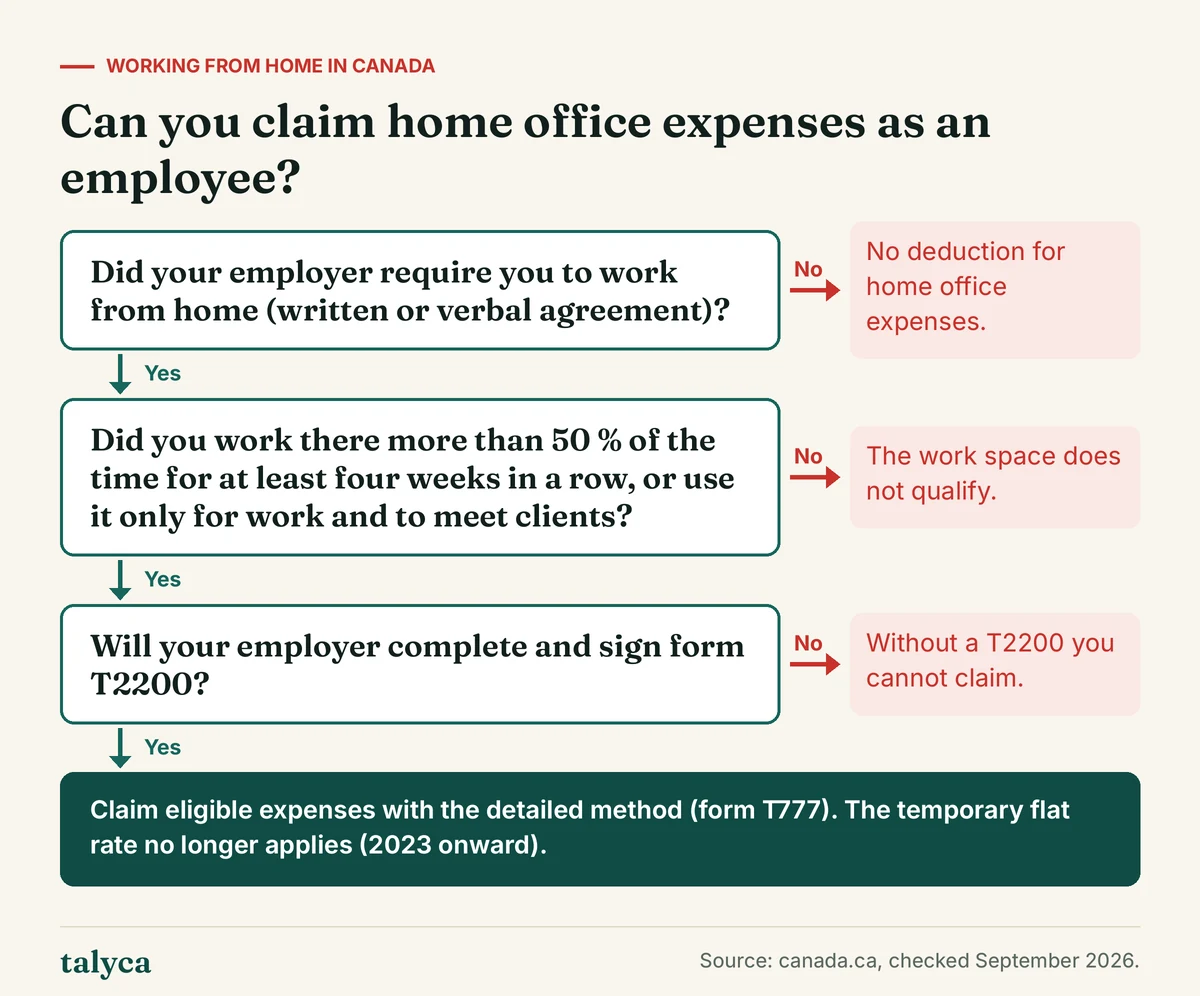
As an employee, you can deduct certain home office expenses on your tax return – but only under specific conditions. The temporary flat-rate method used during the pandemic does not apply from the 2023 tax year onward; you must use the detailed method.
What you can claim
With the detailed method, you claim the work-use share of eligible expenses on form T777. You calculate the share based on the size of your workspace compared with the finished area of your home, and on how much of the time it is used for work if it is also used for other purposes.
| Expense | Salaried employee | Commission employee |
|---|---|---|
| Electricity, heat, water | Yes (work-use share) | Yes |
| Rent | Yes (work-use share) | Yes |
| Maintenance and minor repairs | Yes (work-use share) | Yes |
| Monthly home internet fees | Yes (work-use share) | Yes |
| Home insurance, property taxes | No | Yes (work-use share) |
| Mortgage interest, capital cost allowance | No | No |
Office supplies used up directly in your work (for example, paper or printer ink) can be claimed if your employer requires you to pay for them and doesn’t reimburse you. Computers, furniture and other equipment are generally not deductible for salaried employees.
No tax or legal advice: this is a general overview based on information published by the CRA and government sources (updated September 2026). For your personal situation, check canada.ca, your provincial employment standards office, or a professional.
Working from Canada for a foreign employer
If you live in Canada and work remotely for a company abroad, three situations are common:
- Employer of record: a Canadian EOR employs you on paper and runs Canadian payroll. Tax, CPP and EI are deducted; provincial employment standards apply.
- Foreign employer with Canadian payroll: the company has registered to run Canadian payroll itself. Same effect for you.
- No Canadian payroll: you are paid without Canadian deductions – either as a contractor, or in an arrangement that you should clarify. You report the income yourself and may have to pay tax by instalments.
As a Canadian resident you are taxed on your worldwide income. If tax was withheld in another country, a tax treaty and the foreign tax credit usually prevent double taxation, but you need to claim it. How remote job ads signal these arrangements is explained in remote jobs in Canada; the tech-specific version is in remote tech jobs.
Moving while working remotely
Moving to another province can change which employment standards, payroll taxes and health insurance rules apply to you, and your employer may not be registered there. Tell your employer before you move, and register with the new province’s health insurance plan in time – each province has its own waiting period and rules. Moving abroad while keeping a Canadian job raises further tax and immigration questions and usually needs your employer’s explicit agreement.
Looking for a role with clear terms? Browse remote jobs open to Canada and use the checklist in applying for remote jobs before you sign.
Go deeper on this topic:
- Right to Disconnect in Canada: What the Rules Say for Remote Workers – Ontario’s disconnecting-from-work policy, the federal Canada Labour Code change and what applies in other provinces.
- How to Calculate Home Office Expenses as an Employee – Step-by-step.
Common questions about working from home in Canada
Can my employer make me return to the office?
It depends on your contract and how the arrangement was agreed. If your contract says remote, a change may need your agreement; if remote work was a temporary policy, the employer usually has more room. For a significant change, get advice from your employment standards office or a lawyer.
Can I still use the $2-a-day flat rate for my home office?
No. The temporary flat-rate method applied to the 2020 to 2022 tax years. From 2023 on, employees must use the detailed method with a T2200 signed by their employer.
Does my employer have to pay for my internet?
Not by law in general. Many employers pay an allowance, and as an employee required to work from home you may be able to deduct the work-use share of your monthly internet fees with the detailed method.
Is my employer allowed to monitor my computer?
Employers can monitor work devices within the limits of privacy law, and in Ontario employers with 25 or more employees must tell employees in a written policy how they monitor them. Monitoring your personal devices is far more limited.
Do I get paid for overtime when I work from home?
Yes, if you are an employee who isn’t exempt from overtime rules. The same thresholds apply at home as in the office, and required after-hours work counts.