Tech is the field where remote work is most established, and Canadians can work for employers at home and abroad. This guide maps the main remote tech roles, the skills employers look for, the three ways a company can pay you while you live in Canada, and how technical hiring processes usually run.
The main remote tech roles
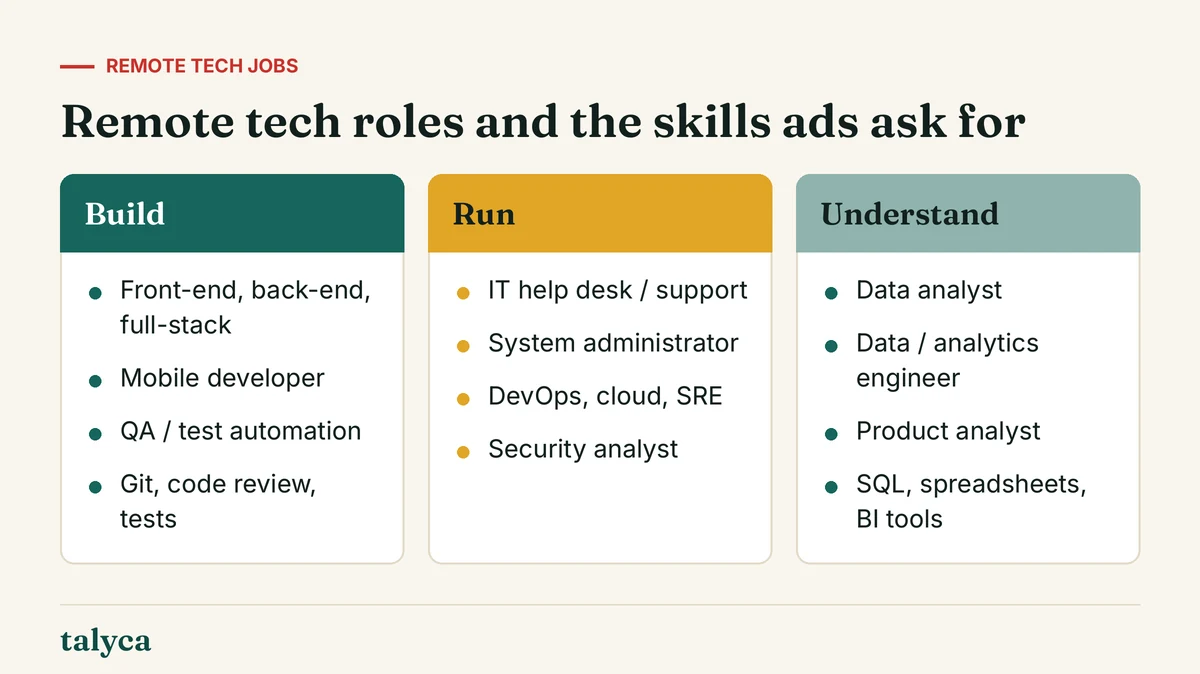
“Tech jobs” covers very different work. It helps to think of three groups: people who build software, people who run systems and support users, and people who understand data. Each group has entry points and a typical skill set.
Build: development and QA
Developers write and maintain software: web front-ends, back-end services, mobile apps. QA engineers test it, increasingly by writing automated tests. Remote teams expect you to work with Git, code review and a ticket system such as Jira, and to write clear pull request descriptions – in a distributed team, your written explanations are part of the work.
Run: IT support, operations and security
IT help desk and desktop support roles are the most accessible way into tech; remote versions handle tickets, remote sessions and account management. With experience, paths lead to system administration, cloud and DevOps work (infrastructure as code, CI/CD pipelines, monitoring) and security (monitoring alerts, managing access, responding to incidents). Some security and government-related roles require a Canadian security clearance, which comes with residency requirements.
Understand: data and analytics
Data analysts turn data into answers with SQL, spreadsheets and BI tools such as Power BI, Tableau or Looker. Analytics and data engineers build the pipelines behind them. These roles suit people who come from finance, operations or research as well as from computer science.
Skills that matter for remote tech work
Technical skills get you considered; remote working skills often decide who gets the offer. Employers hiring remotely look for:
- Written communication: clear tickets, design notes and status updates. Asynchronous teams live in writing.
- Self-direction: breaking down a task, making progress without a manager nearby, and flagging blockers early.
- Evidence of skill: a portfolio, GitHub projects, contributions to open source, or a write-up of a system you built or maintained.
- Current tools: the stack named in the ad. Don’t claim tools you have only read about – technical interviews find out.
- Time zone overlap: many North American teams want several shared hours per day; mention your time zone in your resume.
Tip: For each project in your portfolio, add three sentences: the problem, what you did, and the result. Reviewers read dozens of repositories; a short README that explains the point gets yours read.
Certifications help most in IT and cloud roles (for example, vendor certifications for cloud platforms or networking), less in software development, where your code speaks for you.
Canadian and foreign employers: how you get paid
Many remote tech jobs are advertised by companies outside Canada, especially in the US. Whether they can hire you depends on how they pay people here. There are three common models:
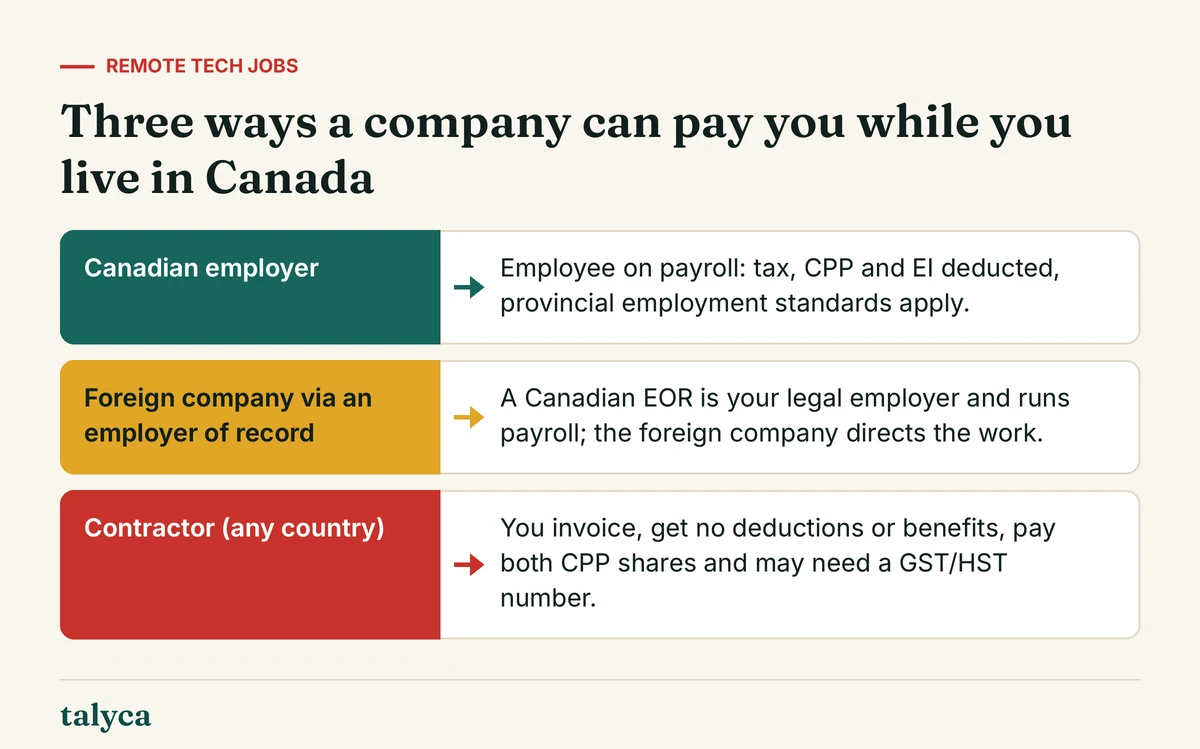
As an employee of a Canadian company or employer of record, income tax, CPP and EI are deducted from your pay, you are covered by employment standards and you may get benefits. As a contractor, you receive the full amount on your invoice, but pay both halves of CPP yourself, get no EI coverage by default, no paid vacation or statutory holiday pay, and may need to register for GST/HST. Compare offers on that basis, not on the headline number. The details for contractors are in our guide to freelancing in Canada.
Watch the label: if a company controls your hours, tools and methods like an employee’s but calls you a contractor, you may in law be an employee. The CRA can rule on your status for CPP and EI purposes. Get the arrangement in writing before you start.
Payment in US dollars is common with American companies. Compare exchange fees between your bank and payment services, and remember that currency swings change your income in Canadian dollars.
Salaries and how to check an offer
Tech pay varies more than in most fields: by role, seniority, company size and whether the employer pays Canadian or US-based rates. Rather than rely on a single figure, compare several sources:
- Job Bank (Government of Canada) publishes wage ranges for occupations such as software developers, computer network technicians and data analysts, by province.
- Salary ranges in job ads. Several provinces now require or are introducing pay transparency in postings; collect the ranges you see for your target role.
- Your network – people a step ahead of you are often willing to share ranges privately.
When comparing an employee offer with a contract, a rough rule is that the contract rate must be noticeably higher just to make up for CPP, benefits, unpaid holidays and gaps between contracts.
How remote tech hiring works
A typical process has four to six steps: a recruiter call, a technical screen, a take-home assignment or live coding session, one or more interviews with the team (technical depth, system design for senior roles, and behavioural questions), then references and an offer. The overall process for remote roles is described in applying for remote jobs.
- Take-home tasks: ask how long they should take, and keep to it. Explain your trade-offs in a short README.
- Live coding: think out loud. Interviewers assess how you approach a problem, not just whether you finish.
- Behavioural questions: prepare stories about disagreements, mistakes and working without supervision.
- Unpaid “trial projects” that look like real client work, or that take days, are a reason to ask questions. Legitimate assignments are limited in scope.
Fake tech jobs exist too: fake recruiters sometimes send a “coding test” repository that installs malware, or ask you to receive and set up equipment for them. Run unknown code only in an isolated environment and verify the recruiter through the company’s official website. More in remote job scams in Canada.
Getting started without tech experience
If you are moving into tech from another field, the most realistic remote entry points are IT help desk, QA testing, technical customer support and junior data analysis. Technical support in particular combines the customer skills described in remote customer service jobs with technical troubleshooting, and it often leads to IT or product roles. Build one or two small projects that match the role, describe them well, and apply to companies whose product you understand. Current listings: developer jobs and all remote jobs open to Canada.
Go deeper on this topic:
- Remote IT Help Desk Jobs: The Most Accessible Way Into Tech – What remote help desk analysts do, how support tiers work, which skills and certifications help, and where the job can lead.
- A Developer Portfolio That Gets Remote Interviews – Which projects to show, how to write a README reviewers read, and how to present your GitHub for remote developer roles.
Common questions about remote tech jobs
Can a Canadian work remotely for a US tech company?
Yes, if the company can pay you here – through a Canadian entity, an employer of record or a contractor agreement. You don’t need a US work visa to work from Canada for a US company, but you do need to report the income in Canada.
Is a contractor rate better than a salary?
Only if it’s high enough to cover what an employer would otherwise pay: both halves of CPP, benefits, vacation and holiday pay, and time without work. Compare the two on the total, not the headline number.
Do I need a computer science degree?
Many employers accept equivalent experience, especially for web development, QA, IT support and data analysis. A degree matters more for some specialised roles and for immigration purposes.
Which remote tech role is easiest to start in?
IT help desk and technical support usually have the lowest entry barrier, followed by QA testing and junior data analysis. They also teach you how companies run their systems.
Should I run a take-home coding test from an unknown recruiter?
Only after checking that the recruiter and company are real, and ideally in a virtual machine or container. Malicious “tests” that steal credentials or crypto wallets have been used against developers.