
Task scams offer “flexible online work” – rating products, boosting apps, liking videos – and really pay out at first. That’s what makes them so effective: by the time the account “needs a deposit”, victims already trust the job. This article shows how the scheme escalates, how to recognise it early, and what to do if you have already paid.
How it starts
Most task scams begin with an unsolicited message: a text, WhatsApp or Telegram message, or a social media DM from a “recruiter” for a digital marketing or e-commerce company. The pitch is always similar – work a few hours a day from your phone, no experience needed, daily pay. Sometimes the company name is borrowed from a real business. Our guide to remote job scams in Canada covers other common schemes; this one deserves its own explanation because it catches so many careful people.
How the scam escalates
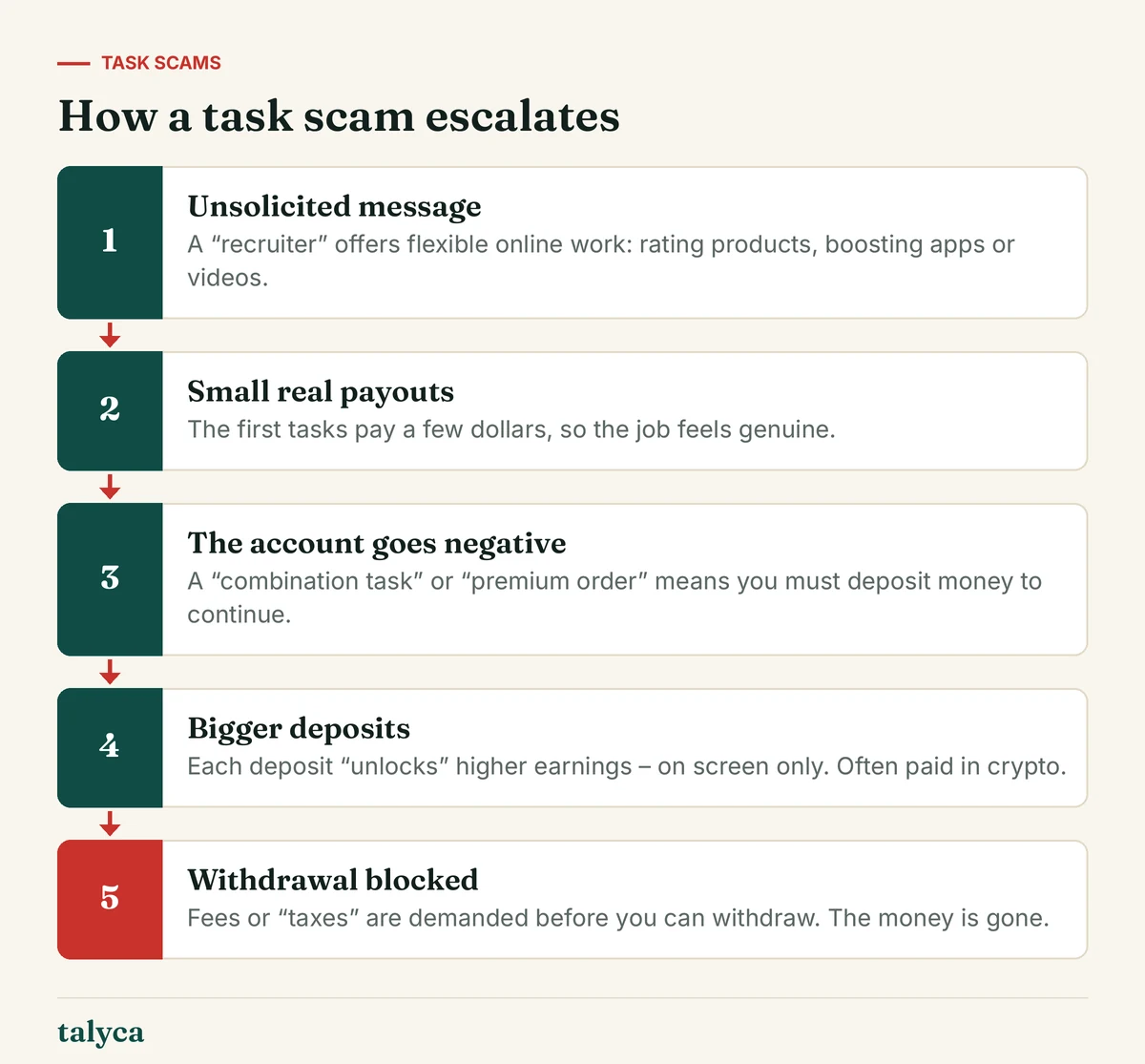
The early payouts are real, and small. They’re the investment the scammers make to earn your trust. Then a “combination task” or “premium order” pushes your account balance below zero, and you’re told to deposit money to continue and to release your earnings. The platform shows your balance growing – but those numbers are just figures on a screen that the scammers control.
Often there’s a group chat with other “workers” celebrating big payouts. Those members are usually part of the scam. The pressure grows: a deadline, a bigger task, a “fee” or “tax” to withdraw. Each deposit is presented as the last one needed.
Warning signs specific to task scams
- You’re paid for simple clicks – ratings, likes, “app boosting” – with no clear business reason.
- You have to deposit money to continue working or to withdraw. No employer ever needs this.
- Payments run through crypto, often with instructions for buying it through an exchange or ATM.
- The work happens on a website or app you’ve never heard of, reached through a link from your “mentor”.
- A trainer or mentor walks you through everything, always available, always friendly – until you hesitate.
- There’s no interview, contract or employer identity – just a platform account.
One rule stops this scam completely: if you have to pay to work or to withdraw your earnings, it’s not a job. Stop at that point, no matter how much you’ve put in.
If you’ve already deposited money
- Stop paying. Every “final fee” leads to another. Money already sent won’t be released by sending more.
- Don’t pay “recovery services” that contact you promising to get your crypto back for a fee – that’s a common second scam aimed at victims.
- Contact your bank if you paid by transfer or card, and the crypto exchange if you bought crypto there. Ask whether anything can be stopped or flagged.
- Save evidence: chats, the website address, wallet addresses, transaction IDs, screenshots of the platform.
- Report it to the Canadian Anti-Fraud Centre (1-888-495-8501) and your local police. Reports help investigators connect cases.
- Secure your accounts if you shared ID documents or logins: change passwords, enable two-factor authentication, and consider a fraud alert with Equifax and TransUnion Canada.
Why it works on careful people
Task scams use well-known psychology: small real rewards build trust, the sunk cost of earlier deposits makes stopping painful, and a friendly mentor and group chat create social proof. Knowing the pattern is the best protection – and sharing it with friends and family, especially students and newcomers looking for flexible work, helps too.
Real flexible remote jobs exist; our guide to entry-level remote jobs lists the realistic ones. Before you respond to any unexpected recruiter, run through how to check if a recruiter is real.
Common questions
Are all online task jobs scams?
No. Legitimate platforms for data labelling, testing or transcription exist. The difference: they pay you and never ask you to deposit money to work or withdraw.
Why did I get paid at first?
Small real payouts are part of the scheme. They build trust so that you’ll deposit larger amounts later.
Can the police get my crypto back?
Recovery is difficult, but reporting helps investigators and sometimes allows exchanges to freeze funds. Report quickly and keep all transaction details.
More on this topic: our guide Remote Job Scams in Canada: 12 Warning Signs and What to Do puts this article in context.